What is SWIFT? A guide to the SWIFT banking system and payments

The Airwallex Editorial Team

Key takeaways
In 2025, SWIFT set a single-day record of 68 million messages across its network of 11,500+ member institutions in 235 countries.¹
SWIFT sends payment instructions between banks but never touches the money. Settlement runs through correspondent accounts, not through SWIFT.
Airwallex Business Account sends 94% of transfers over local payment rails, skipping the SWIFT correspondent system and the intermediary fees that come with it.
Send an international wire and you're almost certainly moving money through SWIFT. The Society for Worldwide Interbank Financial Telecommunication links more than 11,500 banks across 235 countries and handles over $150 trillion in cross-border payments each year,² but transfers take one to five business days and fees from intermediary banks along the route can chip away at the amount that actually lands in the recipient's account. This guide covers how SWIFT works, what it costs, and where faster options exist.
What is the SWIFT banking system?
SWIFT is a global messaging network used by more than 11,500 banks and financial institutions across 235 countries to exchange payment instructions. The most important thing to know: SWIFT never touches the money. It doesn't hold accounts or move funds. It sends messages. That distinction explains a lot about why international payments are slow and why they cost what they do.
What does SWIFT stand for?
SWIFT stands for Society for Worldwide Interbank Financial Telecommunication. It was founded in 1973 by 239 banks across 15 countries to fix a real problem: the telex system banks relied on for cross-border communication was slow, inconsistent, and prone to errors. SWIFT replaced it with standardized message formats, which let banks automate the process and gave international trade the reliable infrastructure it runs on today.
Who owns and regulates the SWIFT network?
SWIFT is a member-owned cooperative based in La Hulpe, Belgium. Given how much of global finance runs through it, the G10 central banks keep tabs on the network, with the National Bank of Belgium as lead overseer. Ownership shares are recalculated every three years based on transaction volume, so the heaviest users carry the most weight in governance decisions.
Who uses SWIFT?
The SWIFT network includes more than 11,500 institutions across 235 countries: commercial banks, investment managers, brokerages, clearing houses, and corporate treasuries. When your team sends an international wire transfer, the SWIFT BIC code is what points the payment to the right bank. Fintech platforms use SWIFT too, mainly for high-value transactions or corridors where local payment networks don't reach.
How SWIFT is used in international sanctions
SWIFT's role as the backbone of global banking communication makes it one of the most effective sanctions tools available. It runs as a neutral cooperative, but EU and Belgian law applies, which means SWIFT has no choice but to comply when the EU or UN orders sanctions. Targeted banks, or entire national banking systems, get cut off from the network and lose access to international payment infrastructure and major reserve currencies.
How SWIFT payments work
A SWIFT transfer is more complicated under the hood than a standard domestic wire. Here's what actually happens between the time you hit send and the moment funds arrive.
1. Your bank creates a SWIFT message
When you send an international wire, your bank builds a standardized SWIFT message with the payment details: amount, currency, recipient account info, and the destination bank's BIC code. Everything that happens next flows from that message.
2. The message travels through the network
SWIFT carries that message to the recipient's bank, or to the first intermediary if there's no direct relationship. No money moves through SWIFT. It only moves instructions. The actual funds settlement happens separately through correspondent accounts.
3. Correspondent banks route the funds
When your bank and the recipient's bank don't have a direct relationship, the payment routes through one or more correspondent banks. Each one processes the SWIFT message, adjusts its internal accounts, and passes the payment along. Every bank added to that chain costs you more time and money.
4. The recipient's bank credits the account
When the last bank in the chain receives and confirms the payment, it credits the recipient's account. The full process typically takes one to five business days from when you initiated the wire, depending on the route.
What is a SWIFT code (BIC)?
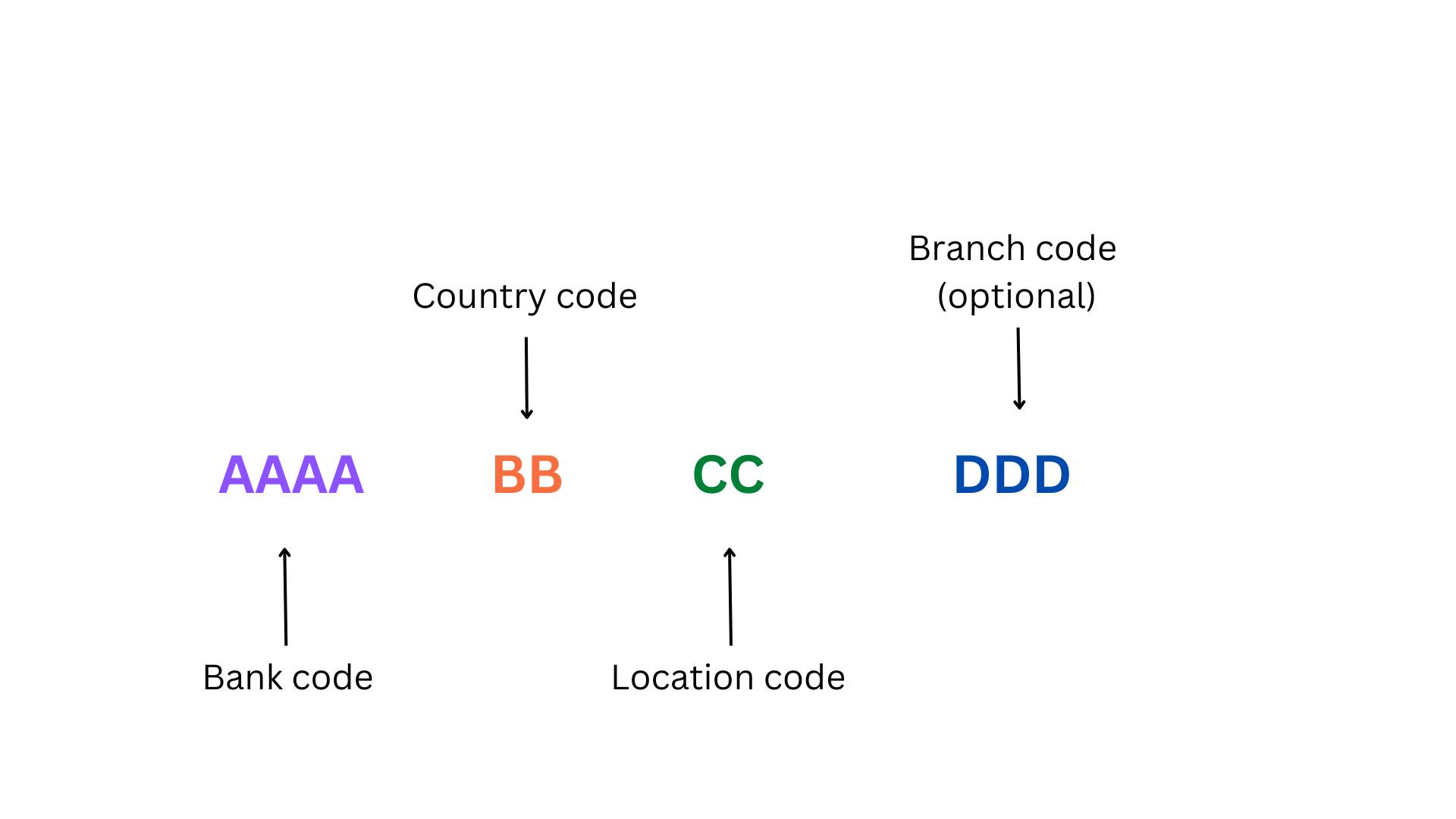
A SWIFT code, also known as a BIC (Bank Identifier Code), is an 8 to 11 character code that identifies a specific financial institution on the SWIFT network. Think of it as a mailing address for your bank. When you send an international wire, the SWIFT BIC tells the network which bank should receive the payment instructions. SWIFT codes are made up of four parts:
Bank code
Country code
Location code
branch code (optional)

SWIFT code, SWIFT ID, and BIC: are they the same thing?
Yes, SWIFT code, SWIFT ID, and BIC all mean the same thing. BIC is the official ISO standard term. SWIFT code is just what most people call it in practice, since SWIFT manages the global BIC registry. You'll see both used interchangeably.
SWIFT code format: what each character means
A SWIFT code is 8 or 11 characters, structured in four segments:
Segment | Length | What it identifies | Example |
|---|---|---|---|
Bank code | 4 letters | The financial institution, usually an abbreviation of the bank's name | CHAS (JPMorgan Chase) |
Country code | 2 letters | The country where the bank is registered (ISO 3166-1) | US, GB, DE |
Location code | 2 alphanumeric | The bank's city or region; a "1" as the second character indicates a passive participant | 33 (New York) |
Branch code | 3 alphanumeric, optional | A specific branch; "XXX" means primary office; omit for 8-character head office code | XXX |
For example, CHASUS33 breaks down as: CHA (JPMorgan Chase), US (United States), 33 (New York).
SWIFT code vs. IBAN: what's the difference?
A SWIFT code identifies the bank. An IBAN (International Bank Account Number) goes further and pinpoints the specific account at that bank. SWIFT codes work globally, while IBANs are mostly used in Europe and the Middle East for automated payment routing. For most cross-border wires into European accounts, you'll need both.
How much do SWIFT transfers cost?
SWIFT transfers come with two separate costs that most senders don't fully account for: layered transaction fees and an exchange rate markup. Together, they can significantly reduce what the recipient actually receives compared to the original invoice amount.
Transaction fees
Your sending bank charges an upfront wire fee, typically $20 to $50. Each correspondent bank in the routing chain may then deduct a processing fee of $10 to $30 directly from the principal, and the receiving bank may add a lifting fee on top of that. Intermediary bank charges alone can reduce the payment amount by 10 to 30%.³ By the time the wire arrives, the beneficiary could receive meaningfully less than the invoiced amount.
Fee type | Who charges it | Typical cost |
|---|---|---|
Sending bank wire fee | Your bank | $20 to $50 |
Intermediary/correspondent fee | Each bank in the chain | $10 to $30 per bank |
Receiving bank lifting fee | Recipient's bank | $10 to $20 |
Exchange rate markup
Commercial banks rarely offer the interbank mid-market rate; they apply a markup of 2% to 4% above it.⁴ Unlike the wire fee, this cost is not disclosed as a line item. It's baked into the rate you're quoted, which makes it easy to overlook and hard to forecast when you're managing cross-border costs at scale.
Cost type | How it's charged | Typical range |
|---|---|---|
Exchange rate markup | Hidden in the quoted rate | 2% to 4% above mid-market |
Total FX cost on $10,000 transfer | Deducted from principal | $200 to $400 |
To cut what you're spending on international transfers, our guide on how to avoid wire transfer fees breaks down your options.
OUR, SHA, and BEN: SWIFT fee allocation codes explained
SWIFT uses three codes to determine who pays the fees:
OUR: The sender covers all charges, including bank fees and intermediary fees. The beneficiary receives the exact invoice amount. Use this when you need to guarantee the recipient gets the full amount.
SHA (shared): The most common option. The sender pays their own bank's fee; the beneficiary pays their bank's fee. Intermediary bank fees may still be deducted from the principal, so the recipient could receive slightly less than invoiced.
BEN: All fees are charged to the beneficiary. The sender pays nothing beyond the principal, but the recipient absorbs all costs and may receive significantly less than expected.
Choosing the right code matters. OUR is safest when the payment amount needs to be exact. SHA works for most routine business payments. BEN is rarely advisable when precision matters.
Limitations of SWIFT banking
SWIFT's global reach is its strength. Its age is its limitation.
SWIFT payments take 1 to 5 business days
The sequential correspondent banking model is the main reason transfers are slow. Funds pass through multiple intermediary accounts, and delays compound across time zones, bank holidays, and weekend closures. SWIFT's own Spotlight on Speed research found that 80% of a payment's journey time occurs after leaving the SWIFT network, caught in local clearing practices and manual processing at the receiving bank.
Compliance holds and how to track a delayed SWIFT payment
International transactions undergo AML and sanctions screening at every step. If a payment triggers a compliance flag, it goes on hold until compliance officers at one or more banks manually review it. To track a delayed SWIFT payment, retrieve the Unique End-to-End Transaction Reference (UETR) from your banking portal and enter it into a SWIFT GPI tracking dashboard. Most major banks now expose this.
How is SWIFT modernizing?
Fintech competition and G20 pressure to speed up and cheapen cross-border payments have pushed SWIFT to modernize. Two major upgrades have come out of that: one focused on payment visibility, the other on data quality.
What is SWIFT GPI?
SWIFT GPI (Global Payments Innovation) was built to address one of the most common complaints about international wires: there was no way to know where your payment was. GPI added end-to-end tracking, with real-time visibility into fees, exchange rates, and timestamps. Today, 75% of GPI payments reach the beneficiary bank within 10 minutes, a big jump from the one-to-five-day window that made cash flow forecasting so unreliable.
ISO 20022: the shift from MT to MX message formats
The second major shift was structural. In November 2025, the global banking community finished its migration to ISO 20022, retiring the MT message format that had been in use for decades. Now over 97% of SWIFT messages run on the XML-based MX format, which carries far more structured data than its predecessor. In practice, that translates to fewer compliance false positives, faster invoice matching, and the groundwork for eventually bringing digital assets and programmable payments onto the same infrastructure.
How to find my bank's SWIFT code?
Your bank's SWIFT code is usually in three places: on your paper bank statement, in your online banking settings or transfer portal, or by calling your bank directly. The SWIFT registry also maintains a centralized BIC directory for verification, useful before initiating a large wire to a new recipient.
Faster alternatives to SWIFT for international business payments
For businesses that can't absorb SWIFT's delays or want to reduce fees, local clearing networks are increasingly the better option.
Local clearing networks: ACH, SEPA, and real-time rails
Local clearing networks settle transactions within a specific region at a fraction of SWIFT's cost. In the US, that's ACH. In the Eurozone, SEPA. In the UK, that's Faster Payments. Since these networks only operate domestically, there are no correspondent banks in the middle, which cuts fees significantly and, in most cases, speeds settlement to near real-time.
How global business accounts route payments without SWIFT
Modern global business accounts work differently than traditional banks. Instead of sending money across borders via SWIFT, they establish local banking details in multiple markets. When you fund a payment, the platform collects it locally and instructs its entity in the destination country to pay out using that country's domestic clearing network. Both legs stay local: no SWIFT, no correspondent bank chain, no intermediary fees.
How Airwallex handles international business payments
Most international payment platforms default to SWIFT and work around its limitations. Airwallex takes the opposite approach, building its infrastructure around local rail routing from the start.
Does Airwallex use SWIFT?
Yes, but not as the default. Airwallex maintains direct SWIFT access so you can reach virtually any bank account globally, but the platform prioritizes local clearing networks wherever they exist. SWIFT is reserved for high-value transactions or destinations where local rails aren't available.
Local rail routing and what it means for settlement speed
Airwallex routes 94% of transactions through local clearing networks across 120+ countries. Around 93% of transfers settle within a few hours or the same day, and 50% arrive instantly. For teams running supplier payments or cross-border payroll, that kind of predictability makes cash flow planning a lot more straightforward.
How Airwallex approaches FX and cross-border fees
The cost advantages follow the same logic. With an Airwallex business account, you get interbank exchange rates, which works out to up to 80% savings on FX fees compared to traditional commercial banks. And because payments move via local rails, there are no intermediary bank fees quietly working through the chain and reducing what your recipient actually gets.
Frequently asked questions about SWIFT
Why are SWIFT wire transfer fees so high?
SWIFT fees are high because each correspondent bank in the routing chain deducts a handling fee directly from the principal. On top of that, most commercial banks add a 2% to 4% markup on the exchange rate, not disclosed as a flat fee but functioning as one. The combination makes SWIFT significantly more expensive than local alternatives.
Can a SWIFT payment settle on weekends or holidays?
No, SWIFT settlement depends on commercial banks and local clearing systems, both of which run on business hours. Payments sent over a weekend or right before a public holiday sit in a queue until the next business day.
Does SWIFT actually transfer money?
No. SWIFT doesn't hold accounts, move cash, or settle anything. It's a messaging network that passes standardized payment instructions from one bank to another. The money moves through correspondent accounts, not through SWIFT.
Nostro and Vostro accounts: how banks settle SWIFT payments
SWIFT settlement runs on bilateral banking relationships managed through Nostro and Vostro accounts. The terms come from Latin ("ours" and "yours") and describe the same account from opposite perspectives. A Nostro account is a foreign-currency account your bank keeps at an overseas correspondent bank. That same account shows up as a Vostro account on the correspondent's books. When a transfer clears, both banks update their ledger balances accordingly.
What is correspondent banking in a SWIFT transfer?
Correspondent banking refers to the intermediary banks a SWIFT payment passes through when the sending and receiving banks don't have a direct relationship. Each one reads the SWIFT message, updates its Nostro and Vostro accounts, and moves the payment to the next stop. That chain is what gives SWIFT its global coverage, but each additional bank in the route adds time and cost.
How long does a SWIFT transfer take to go through?
Most SWIFT transfers clear in one to five business days. The actual timeline comes down to how many correspondent banks are involved, what currencies need converting, and whether time zones or holidays add delays along the route. If you're managing supplier payments or watching cash flow closely, it's worth building that window into your planning.
Sources
1. https://www.swift.com/news-events/news/year-shared-progress-5-highlights-2025
2. https://medium.com/@vineet_74924/cryptos-biggest-competition-is-swift-not-tradfi-29506a157c03
3. https://ramp.com/blog/what-are-swift-payments
4. https://razorpay.com/learn/what-is-swift/
5. https://xlentpay.com/swift-payments-information/
View this article in another region:AustraliaCanada - EnglishCanada - FrançaisEuropeNew ZealandSingaporeUnited KingdomGlobal
The material presented here is for informational purposes only and does not constitute legal, regulatory, taxation, or investment advice. Readers should engage their own advisors or counsel for advice unique to their circumstances.
The Airwallex Editorial Team
Airwallex’s Editorial Team is a global collective of business finance and fintech writers based in Australia, Asia, North America, and Europe. With deep expertise spanning finance, technology, payments, startups, and SMEs, the team collaborates closely with experts, including the Airwallex Product team and industry leaders to produce this content.
Posted in:
Online paymentsShare
- What is the SWIFT banking system?
- How SWIFT payments work
- What is a SWIFT code (BIC)?
- How much do SWIFT transfers cost?
- Limitations of SWIFT banking
- How is SWIFT modernizing?
- How to find my bank's SWIFT code?
- Faster alternatives to SWIFT for international business payments
- How Airwallex handles international business payments


