Payment gateway fees: What businesses need to know

Airwallex Editorial Team

Key takeaways
Payment gateway fees usually include a percentage of each transaction plus a fixed per-payment charge. Depending on the provider, payment method, and whether the payment is domestic or international, fees can range from around 1–5%.
The biggest factors affecting your fees are transaction volume, average transaction size, business industry, accepted payment methods, and chargeback history.
Airwallex offers transparent, competitive payment gateway pricing with no hidden fees, plus built-in multi-currency accounts and 160+ local payment methods to help businesses reduce costs.
If your business processes hundreds or thousands of payments a month, even small fee differences can add up to thousands in lost revenue. Payment gateway fees, the charges you pay to accept online payments, usually range from 1% to 4%+ of each transaction, plus a fixed fee. On a single sale, that might not sound like much. But once your volume grows, it can seriously eat into your margins.
Below, we'll break down the different types of fees, what affects pricing, and how to cut costs without cutting corners. By the end, you'll know how to choose the right payment gateway and keep more revenue in your business.
What are payment gateway fees?
A payment gateway fee is the fee a business pays its payment provider to facilitate online payments. The total cost of card processing can also include amounts paid through to the acquirer, card network, and issuing bank. This fee usually includes a small percentage of the transaction amount, typically 1% to 4%+, plus a fixed fee for each payment processed. There are also several different pricing models, including interchange-plus and flat-rate pricing.
You can think of a payment gateway as the go-between in any online transaction. When a customer makes a purchase, the payment gateway securely sends the payment details to the payment processor. Then it communicates with the customer's bank to confirm the transaction and make sure there are enough funds. Once the transaction is authorised, the payment gateway tells the merchant and helps move the funds to complete the purchase.
Payment gateway fees cover the cost of securely handling, verifying, and processing your customers' payment data. The fee is shared among different entities in the payment process:
The payment gateway provider takes a portion for handling the transaction and providing the platform.
The acquiring bank (the merchant's bank) gets its share for authorising and receiving the payment.
The card networks, such as Visa, Mastercard, or American Express, also charge a small fee for managing the communication between the merchant's bank and the issuing bank (the customer's bank).
These fees help keep payment systems secure, reliable, and efficient. Now that you know what these fees are and who gets them, let's look at how they fit into the payment process itself.
How payment gateway fees work
Online payments take seconds from the customer's point of view, but a lot is happening behind the scenes. Let's walk through the steps in an online payment and point out where payment gateway fees come in.
The customer makes a purchase: When a customer buys something through a website, they add their items to the basket and go to the online checkout. Then they enter their payment details, such as their credit card information, into the payment form.
Information is sent to the payment gateway: Once the customer submits their payment, the payment gateway securely encrypts the customer's payment information. This helps protect the customer’s payment information, and the transaction may also pass through fraud screening tools before authorisation.
The acquiring bank requests authorisation:The payment gateway sends the encrypted payment information to the acquiring bank, which then routes the request through the card network, such as Visa, Mastercard, or American Express, to the issuing bank (the customer's bank). The issuing bank checks whether the customer has sufficient funds or credit.
The payment is either approved or declined: If the payment is approved, the authorisation goes back through the chain to the payment gateway, letting the merchant know they can complete the transaction. If the payment is declined, the payment gateway lets the customer know they need to try again with a different payment method.
Payment gateway fees are deducted: The payment gateway takes a percentage of the transaction, typically 1% to 3.5%, plus a fixed fee per transaction. This covers the costs of all the parties involved.
Funds are transferred and merchant receives payment: Once the transaction is approved, the funds move from the customer's bank account to the acquiring bank, and then to the merchant's account, minus any fees. This transfer can take anywhere from a few hours to a couple of days, depending on the payment method and which financial institutions were involved.
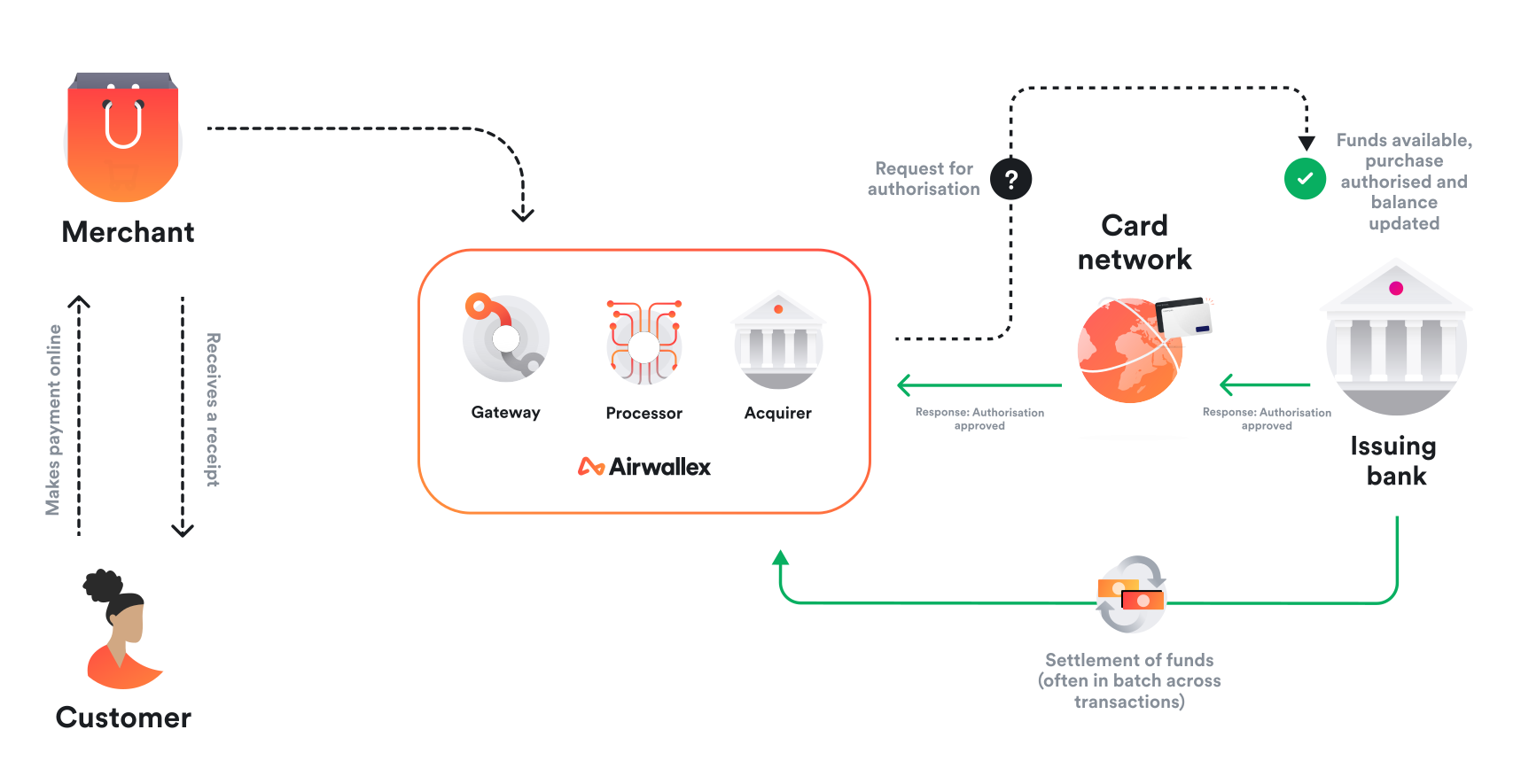
So it's not just one entity handling everything. There are multiple players, and each takes a small cut of the payment gateway fee to make sure payments are processed securely and efficiently. With that in mind, let's look at the specific fees you'll come across.
Types of payment gateway fees
If you're comparing providers, these are the most common fees you'll see on your statements and what they cover.
Transaction fees: These usually include a percentage of each sale plus a fixed amount per transaction. Rates vary by payment gateway provider and payment method, such as credit card or debit card. Transaction fees can have a big effect on your operating costs, so it's worth carefully comparing the fee structures of the providers you're considering.
Monthly fees: Some payment gateways charge a monthly fee for access to their platform. This covers things like access to the software, customer support, and reporting tools.
Setup fees: Many payment gateways charge a one-time setup fee to integrate their services with your website or payment system. This covers the cost of the initial configuration and any setup help you might need.
Annual maintenance fee: Similar to monthly fees, these are recurring costs paid annually to cover things like operations, software maintenance, and customer support.
Chargeback fees: If a customer disputes a transaction and initiates a chargeback (a reverse of their transaction), the merchant may incur a chargeback fee. This compensates the payment gateway for the administration involved in managing the chargeback process.
Refund fees: Some gateways charge a fee when processing a refund. That's because the gateway still has to use resources to handle the transaction, even though it's being reversed.
PCI compliance fees: Payment gateways may charge a fee to keep your business compliant with the Payment Card Industry Data Security Standards (PCI DSS). This helps make sure sensitive payment information is always handled securely.
International transaction fees: For cross-border payments, some payment gateways charge extra, and often high, fees for currency conversion, international transactions, and handling different payment methods. These fees can include both a percentage of the total transaction amount and a fixed charge per transaction.
How much do payment gateway fees cost?
A 1% difference in fees might not sound like much, but if you're processing $100,000 a month, that's $1,000 straight off your bottom line. Knowing the usual fee ranges helps you benchmark what you're paying and spot chances to save.
Typical fee ranges by payment method
Different payment methods come with different costs. Here's what you can generally expect:
Platform | Transaction fees – Domestic | Transaction fees – International |
|---|---|---|
Airwallex | 2.60% + NZ$0.30 | 3.60% + NZ$0.30 |
Adyen | NZ$0.11 + payment method fee | NZ$0.11 + payment method fee |
GoCardless | 1% + NZ$0.40 | 2% + NZ$0.40 |
PayPal | 3.40% + NZ$0.45 | 4.4% + NZ$0.45 |
Stripe | 2.65% + NZ$0.30 | 3.50% + NZ$0.30 |
These ranges vary depending on your provider, your transaction volume, and whether the payment is domestic or international. International transactions usually sit at the higher end or come with extra fees on top.
The real cost at scale
Let's say you're processing $10,000 a month. At a 1.5% rate, you'd pay $150 in fees. At 3%, that rises to $300, which is a $1,800 difference over the year. Now scale that up. A business processing $100,000 a month would pay $18,000 versus $36,000 annually at those same rates. Even small rate differences matter once volume grows.
These fees aren't fixed for everyone. A few different factors affect what you'll end up paying.
Factors that influence payment gateway fees
There are lots of reasons payment gateway fees can vary and change over time. If you understand what drives those changes, you can make smarter choices about payment processing, lower your payment gateway fees, and improve your bottom line.
Transaction volume: One of the biggest factors affecting payment gateway fees is transaction volume. The more transactions a business processes, the better the rates they can negotiate with their payment processing provider. Larger businesses with high transaction volumes are seen as lower-risk and more profitable for payment providers, so they often get lower rates. Smaller businesses with fewer transactions might face higher fees.
Average transaction size: If your business usually handles large transactions, payment providers might charge lower fees per transaction, because those larger amounts help balance out the overall risk and cost. On the other hand, if you're processing lots of small transactions, the fee per transaction can be higher because the processing cost is spread across a smaller amount.
Business industry type: Some industries are seen as higher-risk than others, such as travel, gambling, or subscription services. That's because they may be more prone to fraud or chargebacks. Businesses are categorised based on their risk level through merchant category codes.
Accepted payment methods: Credit and debit card payments generally come with higher payment gateway fees because of the fraud prevention and security measures involved in handling them. Accepting alternative payment methods, like Klarna or Afterpay might reduce fees. The more payment types you accept, the more likely you are to see different fees depending on the method used.
Chargeback history: Chargebacks happen when customers dispute transactions, and payment processors may see businesses with high chargeback rates as risky. If your business has a lot of chargebacks, the payment provider may charge you higher payment gateway fees to cover the extra risk and administrative work involved in resolving those disputes.
The good news is that many of these factors are within your control. So let's look at how to actively reduce what you're paying.
How to reduce payment gateway fees
You don't have to just accept high fees as a cost of doing business. Here are practical ways to make a real difference to your bottom line.
1. Negotiate based on volume
If you're processing a significant number of transactions each month, you have leverage. Review your monthly volume and go to your provider with the data. Some platforms may offer better rates to keep high-volume merchants. Even if you're not there yet, ask what volume thresholds would unlock lower pricing.
2. Choose the right pricing model
Payment gateways offer different pricing models for interchange fees, which are the transaction fees that merchants are charged when accepting card payments from customers, whether online or in-store.
A tiered pricing model usually groups transactions into categories such as qualified, mid-qualified, and non-qualified based on risk and card type. Because transactions can move between tiers, this model can be harder to predict.
With interchange-plus pricing,you pay the underlying interchange and scheme fees for each transaction, plus a fixed provider markup. You can see a breakdown of the fees from the card issuer, card network, and acquirer for each transaction. Whilst it can have a higher initial rate, it can lead to savings in the long run for businesses with higher transaction volumes.
3. Reduce chargebacks
High chargeback rates don't just cost you the sale. They can push your fees up across the board. To prevent chargebacks, write clear product descriptions so customers know what they're getting, respond quickly to customer queries and complaints, and use fraud detection tools to catch suspicious transactions before they go through.
4. Accept lower-cost payment methods
Not all payment methods cost the same to process. Bank transfers often cost less than credit card payments, and some digital wallets come with lower fees than traditional cards. If your customers are willing to use those options, offering them at checkout can reduce your average fee per transaction.
5. Settle in local currencies to avoid FX markups
Cross-border transactions usually come with higher cross-border fees, and forced currency conversions can add another layer of cost. If you're selling internationally, look for a provider (like Airwallex) with multi-currency accounts that let you settle payments in the same currency your customers pay in, so you don't get hit with conversion fees on every transaction.
Common payment gateway fee mistakes to avoid
When you're managing payment gateway fees, the wrong choice can lead to higher fees, operational inefficiencies, and slower business growth over time. Here are some common mistakes businesses make when choosing a payment gateway:
Ignoring contract terms
A common mistake is skipping over the fine print in your payment gateway contract. It's easy to miss hidden fees or terms, such as cancellation fees, monthly fees, or charges for extra services.
Some contracts include automatic renewal clauses that can lock you into unfavourable terms without you realising it. To avoid that, always read the fine print before signing. Don't be afraid to ask your payment processing provider to explain any terms, and make sure you fully understand what you're agreeing to. If you're unsure, consult a legal or financial adviser.
Not comparing payment gateway providers
Many businesses stay with their current payment gateway provider simply because it's convenient. That kind of complacency can lead to overpaying. Payment gateways vary a lot in pricing, service offerings, and transaction costs, so if you don't compare providers, you could miss lower fees or more advanced features.
To avoid that, make sure you shop around for the best provider. Compare transaction fees, monthly charges, customer support options, and security features. Even if you're happy with your current provider, it's worth reviewing your options from time to time to make sure you're still getting the best deal.
Not regularly reviewing your payment processes
Once you've chosen a payment gateway, it's easy to set it and forget it. But payment gateway fees can change over time, and new hidden charges can show up. Make sure you regularly review your statements, track your transaction fees, and watch for any changes in your payment gateway fee billing. That will help you spot irregularities early and take action before fees get out of hand.
Avoiding these mistakes puts you in a stronger position to choose the right provider. So here's what else to look for.
How to choose the right payment gateway
Fees matter, but they aren't the only thing to think about when you choose a payment gateway. The right provider depends on what your business needs. To find the best fit for your specific requirements and business goals, you should also look at things like security, accepted payment methods, integration, customer support, value-added features, and system reliability.
Check that the payment gateway offers a variety of payment methods
77% of consumers claim they will likely abandon their basket if their preferred payment method is unavailable. Optimising your checkout with a variety of payment options, including credit and debit cards, digital wallets like PayPal or Apple Pay, and bank transfers, helps prevent this.
Ask whether it supports multiple currencies
If you're selling globally, your provider should be able to handle multiple currencies and international transactions efficiently and cost-effectively, ideally with competitive exchange rates and low fees for cross-border payments. For example, Airwallex charges 2.60% + $0.30 for domestic transactions and 3.60% + $0.30 for international transactions.
Check that the payment gateway connects easily to existing systems
Your payment gateway should work smoothly with your eCommerce platform, accounting software, and Customer Relationship Management (CRM) tools. A smooth payment gateway integration will save your team time, reduce manual errors, and make it easier to track your cash flow.
Look for strong security measures
To keep your customer's sensitive financial information safe, and to help protect your business from fraud or data breaches, look for a provider that offers robust fraud protection, data encryption, and PCI DSS (Payment Card Industry Data Security Standard) compliance.
Look for great customer support
Look for a payment gateway with accessible, responsive customer service that can help with any technical issues or questions, ideally 24/7. Good support can save you a lot of time and frustration later on. And remember, cheaper payment gateways aren't always the best option if their customer service is poor. When things go wrong, whether it's a technical issue or a transaction dispute, you want a provider that's helpful, responsive, and fast. Poor customer service can lead to extended downtime or unresolved issues that affect your cash flow, and that can end up costing you more than paying a little extra for better support.
Check that the payment gateway can grow with your business
Can the provider grow with your business as your transaction volume increases or your business needs change? A scalable solution will help you avoid the hassle, and the potential cost, of switching providers as your business expands.
If you're looking for a provider that ticks these boxes, here's how Airwallex compares.
Cut down payment gateway fees with Airwallex
Our fee structure is transparent and competitively priced for both domestic and international transactions. Airwallex Payments also includes fraud detection to help reduce chargebacks, with security monitoring around the clock. We process over US$150 billion in payments annually for 200,000+ businesses worldwide.
Alongside low and transparent costs, here's how we provide more value to businesses:
Cost-saving multi-currency accounts and FX
When businesses sell internationally, many payment providers require them to set up additional local bank accounts to accept funds in multiple currencies. With Airwallex, businesses can avoid that manual process and reduce their payment gateway fees with built-in multi-currency Global Accounts. Businesses won't pay any forced currency conversion fees when they settle payments in the same currencies as their customers'. They can then pay out from those same balances with no currency conversions needed. When businesses do need to convert funds, they can do so with market-leading FX rates for 60+ trade currencies and save up to 80% on fees.
Global coverage with 160+ local payment methods
Businesses can reach more customers globally by accepting all major card schemes like Visa, Mastercard, and Amex, as well as 160+ local payment methods in 180+ countries. This broad coverage means businesses can avoid having to change providers or pay for multiple providers as they grow into new markets.
Easy integration with no-code, low-code, and API options
With Airwallex, businesses can get started in minutes using no-code plugins, low-code options, or full API integrations, from Payment Links and Plugins to Payments APIs to build their own solution. We also offer 24/7 customer support if businesses ever need a hand.
Airwallex is more than just a payment gateway. It's a comprehensive payment partner with tools that let businesses receive, hold, transfer, and manage multi-currency funds all in one place. That doesn't just save them fees from subscribing to multiple platforms. It also saves them the hours they'd otherwise spend managing all of them.
Frequently asked questions
What are payment gateway fees?
Payment gateway fees are charges businesses pay to process online transactions, usually a percentage of each sale (typically 1–4%+) plus a fixed amount per transaction. These fees are shared among the gateway provider, acquiring bank, and card network.
How much do payment gateway fees typically cost?
Most payment gateways charge a percentage of each transaction plus a fixed fee where applicable, but the exact amounts vary significantly by provider and payment method.
What's the difference between a payment gateway fee and an interchange fee?
An interchange fee is the specific charge set by card networks (like Visa or Mastercard) that goes to the card-issuing bank, while a payment gateway fee is the broader charge from your gateway provider that may include the interchange fee plus their own markup. Interchange fees are one component of the total payment gateway fee.
Is a 3% transaction fee high?
A 3% fee is at the higher end of the typical range and can add up quickly at scale. For example, on $100,000 in monthly transactions, 3% means $3,000 in fees, compared to $1,500 at 1.5%.
Sources
https://www.paypal.com/nz/business/paypal-business-fees#fixed-fees-commercialtrans
https://www.adyen.com/en_AU/pricing
https://www.adyen.com/pricing
https://gocardless.com/en-nz/partners/
https://gocardless.com/en-nz/pricing/
https://www.paypal.com/nz/business/paypal-business-fees
https://stripe.com/nz/pricing
https://www.shopify.com/nz/pricing
The information in this article is based on our own online research. Airwallex was not able to manually test each tool or provider. The information is provided for educational purposes only and a reader should consider the specific requirements of their business when evaluating providers. This research is reviewed annually. If you would like to request an update, feel free to contact us at [[email protected]]. Airwallex (New Zealand) Limited is registered with the New Zealand Financial Service Provider Register (FSP No. 1001602) to provide a range of financial services in New Zealand.
View this article in another region:AustraliaEuropeSingaporeUnited KingdomUnited StatesGlobal
The material presented here is for informational purposes only and does not constitute legal, regulatory, taxation, or investment advice. Readers should engage their own advisors or counsel for advice unique to their circumstances.
Airwallex Editorial Team
Airwallex’s Editorial Team is a global collective of business finance and fintech writers based in Australia, Asia, North America, and Europe. With deep expertise spanning finance, technology, payments, startups, and SMEs, the team collaborates closely with experts, including the Airwallex Product team and industry leaders to produce this content.
Posted in:
Online paymentsShare
- What are payment gateway fees?
- How payment gateway fees work
- Types of payment gateway fees
- How much do payment gateway fees cost?
- Factors that influence payment gateway fees
- How to reduce payment gateway fees
- Common payment gateway fee mistakes to avoid
- How to choose the right payment gateway
- Cut down payment gateway fees with Airwallex


