
Key takeaways
CHAPS is a same-day payment system run by the Bank of England. It's usually used for high-value, time-sensitive transfers, and there's no upper limit.
BACS processes Direct Debits and Direct Credits over a three-day cycle. That makes it a low-cost choice for routine business payments like payroll and supplier invoices.
For international payments, Airwallex offers faster transfers at interbank FX rates, with 95% arriving the same day or within hours.
CHAPS and BACS are the two main payment systems for moving money between UK bank accounts, but they work in very different ways. CHAPS is built for same-day, high-value payments where timing matters. BACS is for routine, batch payments that take three working days to clear. So when you're choosing between them, it comes down to how fast the money needs to arrive and how much you're willing to pay.
In this guide, we'll walk through how CHAPS and BACS work and when it makes sense to use each one. We'll also show where Faster Payments fits in, and cover what to do when your payments need to cross borders.
What is a CHAPS payment?
CHAPS stands for Clearing House Automated Payment System. It's a bank-to-bank payment system run by the Bank of England, and it settles payments in real time on the same day you send them. Think of it as the express lane for UK payments: you pay more, but the money is guaranteed to arrive that day. On an average day, CHAPS settles around £400 billion in payments, which makes it a cornerstone of the UK's financial infrastructure.¹
Despite what you might read elsewhere, there's no official minimum amount for CHAPS payments. A lot of banks set their own limits, often around £10,000, to put people off using CHAPS for smaller transfers. There isn't any upper limit, though. That's why CHAPS is the standard choice for high-value deals like buying property.
CHAPS payments are irrevocable. Once you submit a payment and it's processed, it's very hard to cancel or reverse it. That's intentional, because it gives the recipient certainty that the funds are theirs. CHAPS also has wide reach: there are over 30 direct banking participants, and more than 5,000 financial institutions across the UK can make and accept CHAPS payments.¹ CHAPS uses SWIFT messaging infrastructure for domestic sterling transfers.
Common use cases for CHAPS
Businesses usually use CHAPS when a payment is both high-value and time-critical:
Property completions and real estate transactions
Large one-off supplier payments
Tax payments (VAT, corporation tax)
Legal settlements and court-ordered payments
Emergency same-day transfers where delays would cause problems
In each case, the main point is the same. The recipient needs to know the money will arrive today, and the amount is large enough to justify the higher fee.
CHAPS fees and cut-off times
CHAPS payments usually cost £20 to £35 per transfer.¹ The exact fee depends on your bank and whether you send the payment online or in-branch. It's one of the more expensive ways to move money in the UK, so it's best to keep CHAPS for times when same-day settlement really matters.
Cut-off times vary by bank and by how you send the payment. If you're paying in-branch, you usually need to submit it by 3pm. For online banking, cut-offs are often around 5pm. Miss the cut-off, and the payment will go the next business day. CHAPS only runs on business days, not weekends or bank holidays, so you need to plan ahead if you're working to a deadline.
CHAPS is a good fit when same-day settlement matters. But if you're making routine payments and the three-day cycle is fine, BACS is usually the better choice.
What is a BACS payment?
BACS stands for Bankers Automated Clearing Services. It's the workhorse of UK business payments, processing billions of transactions each year.² If you've ever been paid your salary, paid a bill by Direct Debit, or paid a supplier, there's a good chance BACS was involved.
BACS is now run by Pay.UK. It handles two types of payment: Direct Debits, where the payee pulls funds from your account, and Direct Credits, where you push funds to someone else's account. BACS processes payments in batches over a three-day cycle. That keeps costs low, but it also means you have to plan ahead.
The upper limit for BACS payments is £20 million per transaction.² That covers almost any routine business payment. And because BACS is built for bulk processing, the cost per transaction is very low, often free or just a few pence. To set up BACS payments, you'll need the recipient's sort code and account number.
Direct Debits vs Direct Credits
To choose the right BACS option, it helps to know how these two payment types are different:
Direct Debit: The payee pulls funds from the payer's account. This is how most repeat bills work. You set up a Direct Debit mandate, and the company takes payments when they're due. Examples include:
Utility bills (gas, electricity, water)
Subscription services and memberships
Mortgage and loan repayments
Insurance premiums
Direct Credit: The payer pushes funds to the payee's account. This is how businesses usually pay money out. Examples include:
Pension contributions
Tax refunds from HMRC
The BACS three-day processing cycle
BACS payments follow a clear three-day cycle:
Day 1 (Input): You submit your payment instructions: who you're paying, how much, and from which account.
Day 2 (Processing): BACS processes and sorts all the payment instructions it's received. It matches payers and payees across participating banks.
Day 3 (Entry): Funds are credited to the recipient's account and debited from your account at the same time. This is when the money actually moves.
So, if you want someone to get the money on Friday, you need to submit the payment by Wednesday. BACS doesn't run on weekends or bank holidays, so you should factor those in too.
Key differences between CHAPS and BACS
When you're choosing between CHAPS and BACS, you're really balancing speed, cost, and what the payment is for. Here's how they compare, with Faster Payments included as a third option:
Feature | CHAPS | BACS | Faster Payments |
|---|---|---|---|
Processing time | Same day (if before cut-off) | 3 working days | Seconds to 2 hours |
Typical cost per transfer | £20–£35 | Free or a few pence | Free or small fee |
Payment limit | No upper limit | £20 million | Up to £1 million (varies by bank) |
Best suited for | High-value, time-critical payments | Routine bulk payments | Everyday transfers under £1 million |
Availability | Business days only, until cut-off | Business days only | 24/7, including weekends |
Reversibility | Very difficult to cancel | Can sometimes be cancelled before processing | Difficult to reverse once sent |
You'll see Faster Payments in the table above. We'll get to that in a moment, but first let's look at the main things that should shape your decision.
Speed and processing times
Speed is often the deciding factor. CHAPS gets the money there the same day, as long as you send it before the cut-off. BACS takes three working days. That's fine for planned payments, but risky if you're up against a deadline. Faster Payments sits between the two, giving you near-instant transfers without a CHAPS-level fee.
For businesses, speed isn't only about convenience. If you pay suppliers quickly, you may get early payment discounts. Delays in payroll processing can damage employee trust. And in property deals, missing a completion deadline can break an entire chain.
Costs and fees
CHAPS costs £20 to £35 per transfer. That can add up quickly if you're sending several high-value payments. BACS is basically free for most businesses, because the cost per payment is tiny. Faster Payments sits in the middle. It's usually free for personal accounts, and often comes with a small fee for business accounts.
The trade-off is simple. If same-day settlement is worth £25 to £35 to you, use CHAPS. If it isn't, BACS or Faster Payments can do the job for much less.
Payment limits
CHAPS has no upper limit. That makes it the only option for very large transfers, like multi-million-pound property deals or corporate acquisitions. BACS has a £20 million limit per transaction, which covers most business needs. Faster Payments is usually capped at £1 million, although some banks set lower limits.³
If you regularly send more than £1 million, you'll probably need CHAPS or BACS. For most day-to-day business payments, Faster Payments is enough.
Payment security: Is CHAPS more secure than BACS?
Both CHAPS and BACS are secure, regulated payment systems, so the question isn't really which one is "safer". The real difference is in the kind of protection each one gives you.
CHAPS settles through the Bank of England with irrevocable finality. Once the payment clears, it's done. You can think of it like recorded delivery: once it's signed for, there's no taking it back. That certainty matters when you're completing a property purchase or settling a legal matter, but it also means you need to double-check the details before you send it.
BACS Direct Debits, on the other hand, come with the Direct Debit Guarantee. If a company takes an incorrect payment from your account, you can claim a full refund from your bank. It's more like an ongoing arrangement with a money-back guarantee if something goes wrong, which is useful protection for recurring payments like subscriptions or utility bills.
So the "security" difference comes down to what you need: CHAPS gives the sender certainty of finality, whilst BACS gives the payer a safety net for recurring payments.
Which payment method should you use?
Here's a quick guide based on common business scenarios:
Buying property or completing a legal settlement: Use CHAPS for guaranteed same-day finality
Running monthly payroll: Use BACS Direct Credit, because the three-day cycle is predictable and costs are minimal
Collecting recurring subscription payments: Use BACS Direct Debit so customers benefit from the Direct Debit Guarantee
Paying an urgent invoice under £1 million: Use Faster Payments for near-instant transfer without CHAPS fees
Paying an international supplier: Use Airwallex for faster, lower-cost cross-border payments
What is Faster Payments and how does it compare?
Faster Payments is the UK's real-time payment system, run by Pay.UK. When you make a bank transfer in your online banking app, it's often sent through Faster Payments. The system sends payments in seconds to two hours, runs 24/7 including weekends and bank holidays, and is usually free or low cost.
You can think of Faster Payments as the middle option between CHAPS and BACS. You get near-instant transfers without paying £25+ each time. The trade-off is a lower payment limit than either system, usually £1 million, although it depends on your bank.³
When to use Faster Payments instead of CHAPS or BACS
Faster Payments is often the best choice when:
You need speed but the amount is under £1 million
You want to avoid CHAPS fees for a same-day transfer
You need to pay outside business hours (evenings, weekends, bank holidays)
You're making a one-off payment that doesn't suit BACS's batch processing approach
You're refunding a customer or moving money between your own accounts
On the other hand, use CHAPS when the payment is above Faster Payments limits, or when you need the guaranteed finality that comes with Bank of England settlement. Use BACS when you're sending bulk or recurring payments, like payroll, and the three-day cycle is fine, especially when the lower per-payment cost matters.
CHAPS, BACS, and Faster Payments work well for UK domestic transfers. But once your payments need to cross borders, you need a different approach.
How Airwallex helps with international payments
CHAPS, BACS, and Faster Payments are great for UK payments. Once your business needs to send or receive money across borders, though, you'll need different international payment methods. Cross-border payments involve other currencies, correspondent banking networks, and often higher fees.
Airwallex gives you a faster, lower-cost way to send money internationally. Instead of routing payments through a chain of correspondent banks, and paying each one, we use local payment networks in each country to move money more directly. As a result, 95% of transfers arrive the same day or within hours. You also get interbank exchange rates, which can save you up to 80% on FX fees compared with traditional banks.
That means you can use BACS for UK payroll and Airwallex for paying international suppliers, and manage both in one financial platform. Here's what you get with an Airwallex Business Account:
Interbank FX rates: Convert currencies at rates usually reserved for large financial institutions, helping you
95% same-day arrival: Most international transfers arrive the same day or within hours
Global Accounts in 20+ currencies: Get paid using local bank details, so customers can pay you like a local business
No transfer fees: Send international payments at competitive, transparent rates
150,000+ businesses served globally: Join companies already using Airwallex to simplify their international finances
If you're looking to compare business accounts or want an easier way to manage both UK and international payments, Airwallex can help.
Frequently asked questions
Why use CHAPS instead of BACS?
Use CHAPS when you need guaranteed same-day settlement for a high-value payment, such as a property purchase or a large supplier invoice. CHAPS costs more, at £20–£35 per transfer compared with pennies for BACS, but you're paying for speed and finality. If the three-day BACS cycle works for your payment, you'll spend less by using BACS instead.
What are the disadvantages of CHAPS?
The main downsides are higher fees (£20–£35 per transfer), strict cut-off times, and limited availability. If you miss your bank's cut-off, usually 3pm to 5pm, your payment won't be sent until the next business day. Because CHAPS settles in real time, there's also very little time to stop a payment if you make a mistake. And CHAPS only runs on business days, so you can't use it on weekends or bank holidays.
Can you cancel a CHAPS or BACS payment?
CHAPS payments are very hard to cancel once you submit them, because they settle in real time. By the time you notice a problem, the money has usually already arrived. With BACS, you can sometimes cancel a payment before the cycle finishes.
For example, if you spot the mistake on Day 1 or early on Day 2, your bank may be able to stop it. But once a BACS payment reaches Day 3 and clears, you'll need to contact the recipient to arrange a refund. If you're setting up a new business account, it's worth learning your bank's cancellation rules for each payment type.
Is CHAPS more secure than BACS?
Both CHAPS and BACS are secure, regulated payment systems. CHAPS settles through the Bank of England with irrevocable finality, which gives recipients certainty that the funds are theirs. BACS Direct Debits are protected by the Direct Debit Guarantee, which lets payers claim refunds for incorrect payments.
The "security" difference is about the kind of protection involved: CHAPS offers finality for the sender, whilst BACS offers a safety net for the payer, not whether one is inherently safer than the other.
Is CHAPS the same as SWIFT?
No. CHAPS and SWIFT are different systems with different jobs. CHAPS is a UK domestic payment system for same-day sterling transfers, run by the Bank of England. SWIFT is a global messaging network that banks use to send payment instructions, often called telegraphic transfers, for international payments.
CHAPS does use SWIFT messaging infrastructure to send instructions between banks, but CHAPS itself only handles UK domestic payments.
For international transfers, you'd usually use SWIFT-based correspondent banking or an alternative provider like Airwallex.
Sources and references
https://www.bankofengland.co.uk/payment-and-settlement/chaps
https://www.wearepay.uk/what-we-do/bacs/
https://www.wearepay.uk/what-we-do/faster-payments/
The material presented here is for informational purposes only and does not constitute legal, regulatory, taxation, or investment advice. Readers should engage their own advisors or counsel for advice unique to their circumstances.

Alex Hammond
Senior Fintech Writer
Alex is a senior Fintech writer at Airwallex with over eight years of experience writing for leading finance and technology brands, such as Lightspeed and Xero. At Airwallex, he writes practical content on payments, financial operations, and international growth for businesses scaling across global markets.
Posted in:
TransfersShare
Create an Airwallex account today
Share



Watch a 3-minute demo
Open a business account built for growth
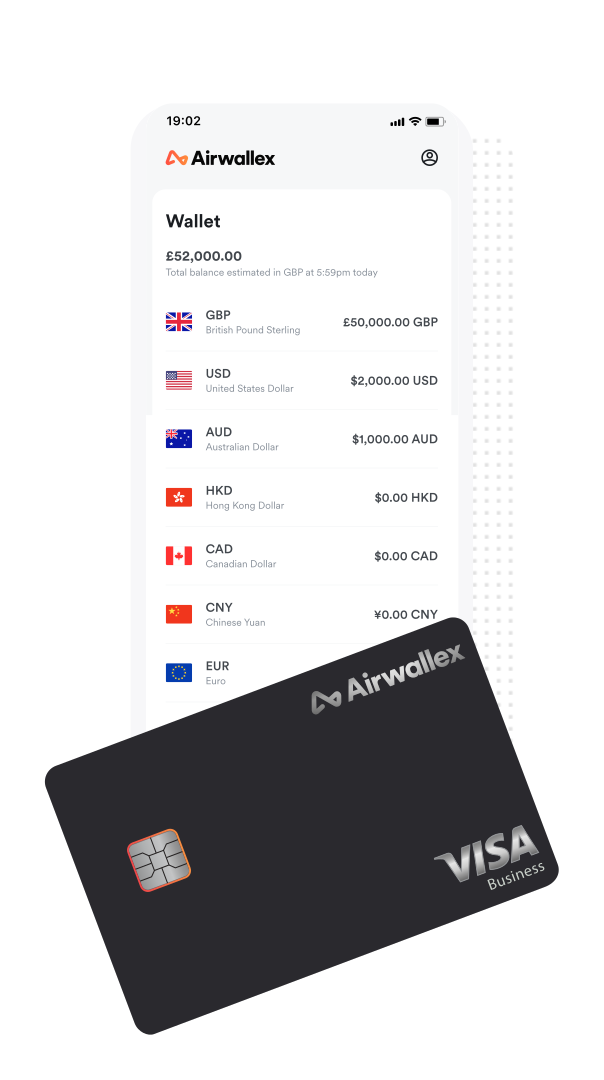

Reach new markets with foreign currency accounts

Transfer funds across the globe, without excessive fees

Empower your team to make purchasing decisions
