

Agentic Commerce SuiteEarly access
Sell to shoppers who arrive with an AI agent. One integration supplies your catalog, confirms checkout, and takes the payment.
Agentic Commerce Suite connects your commerce systems to AI agents through one integration. Shoppers are starting to buy through an assistant instead of browsing your website. The shopper asks, and the agent searches, compares, builds the basket, and pays. Your website may never see the browser.
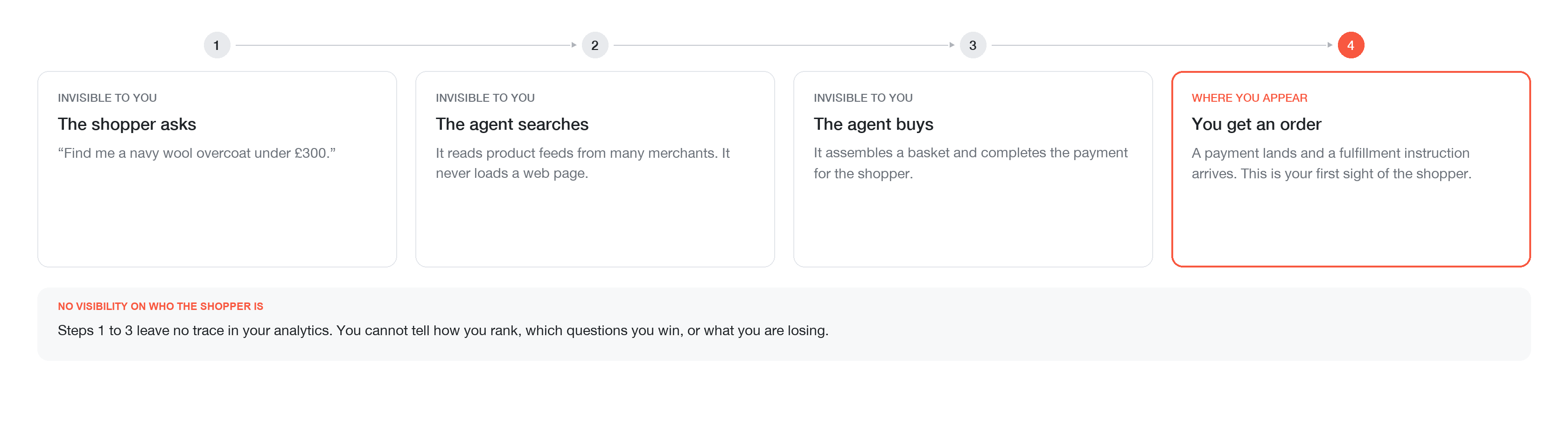
Integrate with Airwallex once. You supply a product feed and, on the end-to-end path, one Create a checkout API. Airwallex handles the rest, including supporting each agent standard, tokenizing payment credentials, managing checkout sessions, and sending the result to your existing payment rails. You remain the Merchant of Record and stay legally responsible for the sale.
Agentic Commerce Suite is available to a limited set of merchants and is enabled per account. To get access, contact your Account Manager. See Enable Airwallex Agentic Commerce Suite.
Why this matters
How shoppers find your products is changing, and so is the way they pay. This section calls the finding part discovery.
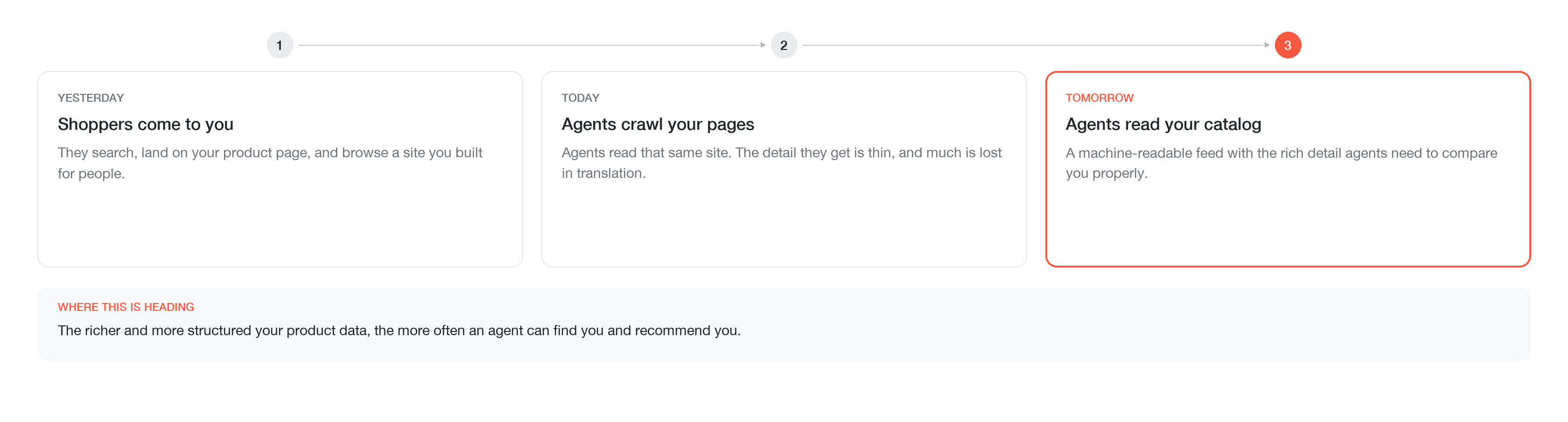
How shoppers find products
- Shoppers came to your storefront.
- Agents now crawl a site built for people. Those pages leave out the product data an agent needs to compare what you sell.
- Agents read your catalog directly, in a machine-readable format with the metadata they need to compare products.
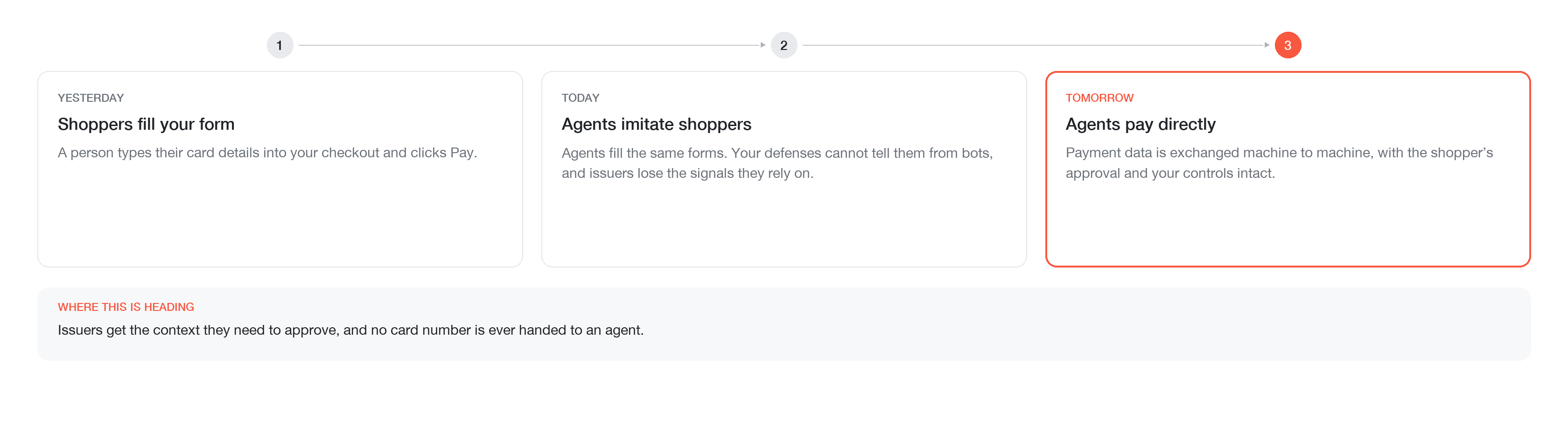
How shoppers pay
- Shoppers filled in your checkout form and chose Pay.
- Agents now mimic shoppers on those same forms.
- Agents exchange payment data directly, with the shopper's approval and your controls intact.
Where the journey breaks
With an agent in the middle, the journey breaks before the sale, and again at the sale.
- Agents cannot read your products. Agents discover and compare through structured product data, not through web pages built for people. If your details are hard to reach, you are overlooked. None of that traffic touches your analytics, so you cannot tell which searches you win or lose. A feed that drifts out of date causes the opposite problem: the agent recommends something you cannot sell, checkout fails, and the shopper blames you.
- Agent payments get declined. A checkout built for a person may treat a legitimate agent as a bot and end the sale before it starts. Payments that do get through can reach the issuer without 3D Secure, device history, or session data, so more of them are refused. The agent also needs a way to pay that never puts the shopper's card number in its hands.
Fixing this should not mean building for every agent. Each agent platform wants your catalog and your checkout in a different shape, and the standards are still changing. Integrate with each one directly and you build once per surface, then rebuild when a specification changes.
Key terms
| Term | Meaning |
|---|---|
| Agent | Software acting for a shopper: an assistant on your site, or a third-party agent such as ChatGPT, Claude, or Gemini. |
| Discovery | How an agent finds and compares your products. An agent reads a product feed rather than your web pages. |
| Checkout | Everything between a chosen basket and a payment: confirming availability, delivery options, and the final price. |
| Product feed | The structured file of everything you sell, including name, description, price, and availability, with one entry for each item a shopper can buy. |
| Agent protocol | The protocol an agent uses to talk to a merchant. ACP and UCP today. You integrate with Airwallex, not with a standard. |
What Airwallex does
Airwallex is the connection between your backend systems and AI agents. You integrate once. Airwallex speaks each agent standard. When a new standard is added, the integration you build does not change.
Everything in the Suite works toward one of two outcomes:
- Be discoverable. Agents can read, compare, and recommend your products.
- Get paid. An agent's purchase completes, and the issuer approves it.
| Component | Outcome | What it does |
|---|---|---|
| Agentic Checkout | Be discoverable | Serves your catalog to any agent through one connection, and confirms every checkout against your own systems. |
| Agent Trust & Risk | Both | Identifies which agents are reaching you so you can allow or block them agent by agent, and records what the shopper approved. |
| Agentic Token Vault | Get paid | Lets agents pay with saved cards without seeing a card number. Delegated payment tokens are single-use and locked to one merchant, amount, session, and time window. |
| Agentic Payment Rails | Get paid | Carries agent context through to the issuer so more agent payments are approved, and reports agent-led volume separately. |
Agent-led payments are scored by the Airwallex fraud engine, alongside the rest of your traffic. Agent allow and block lists are operated by Airwallex. Ask your Account Manager about the policy applied to your account.
A shopper reaches you through an AI agent or through your own storefront. Behind both, one connection to Airwallex serves every protocol.
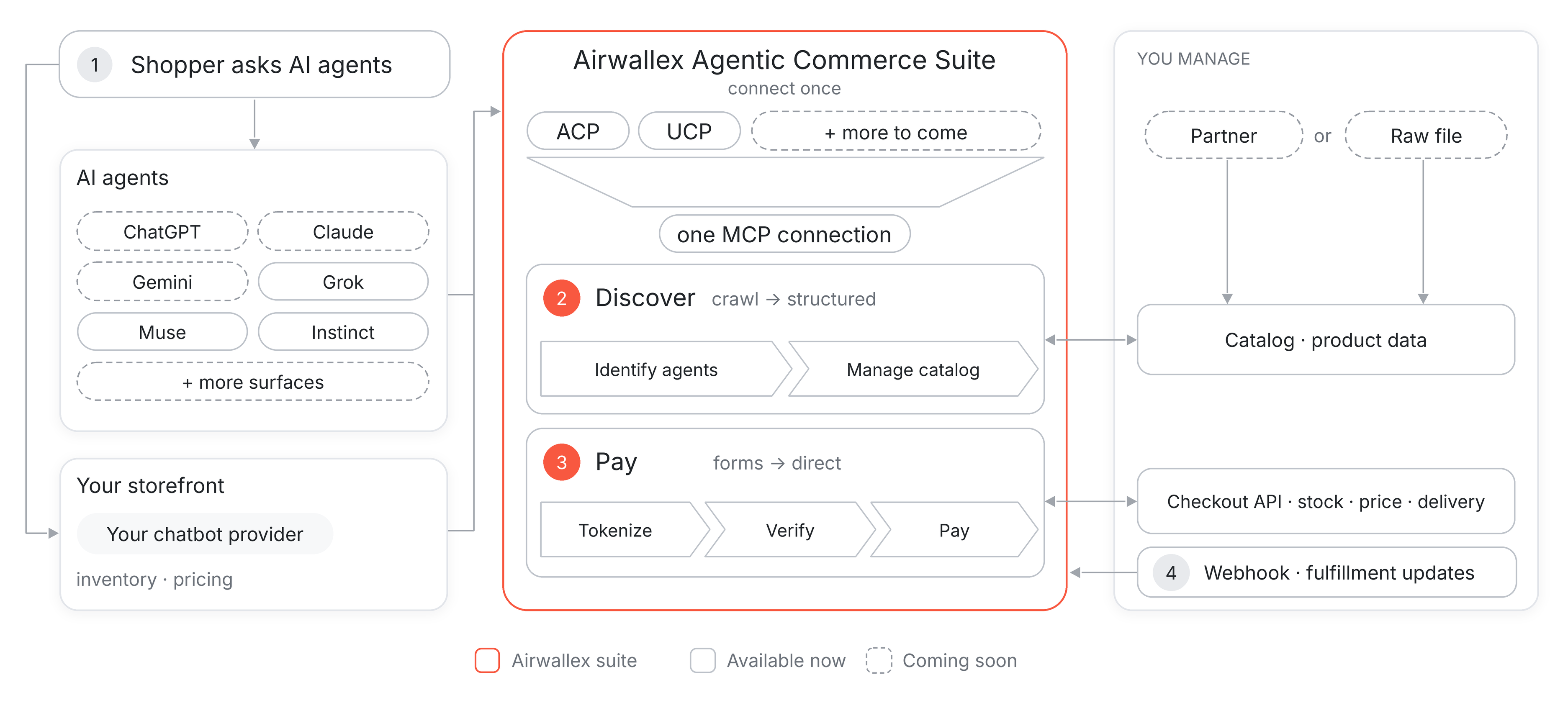
Airwallex runs discovery and payment on your behalf. For discovery, Airwallex identifies agent traffic, hosts your catalog, and serves it to the agent. For payment, Airwallex verifies the agent, tokenizes the payment credential, runs fraud checks, and processes the payment.
What you still manage
| What you manage | What it covers |
|---|---|
| Catalog | Your product data, from a file you send Airwallex. |
| Create checkout API | Stock, price, and delivery, confirmed by your systems at the moment of purchase. |
| Shopper authentication | On your own storefront, the session token endpoint. On external surfaces, an OAuth server and a JWKS URL for signed-in shoppers. |
| Chat completions | Required for the Assistant SDK. When Airwallex hosts the model, the SDK calls https://copilot.airwallex.com/v1/chat/completions. When you host the model, you provide your own chat completions URL. |
| PaymentIntent Webhook | The signal that money moved. You fulfill the order when it arrives. |
On the payment-only paths you do not supply a catalog, a create checkout API, a session token endpoint, or OAuth. You create the PaymentIntent yourself. See Choose how you use it.
Existing shopper traffic
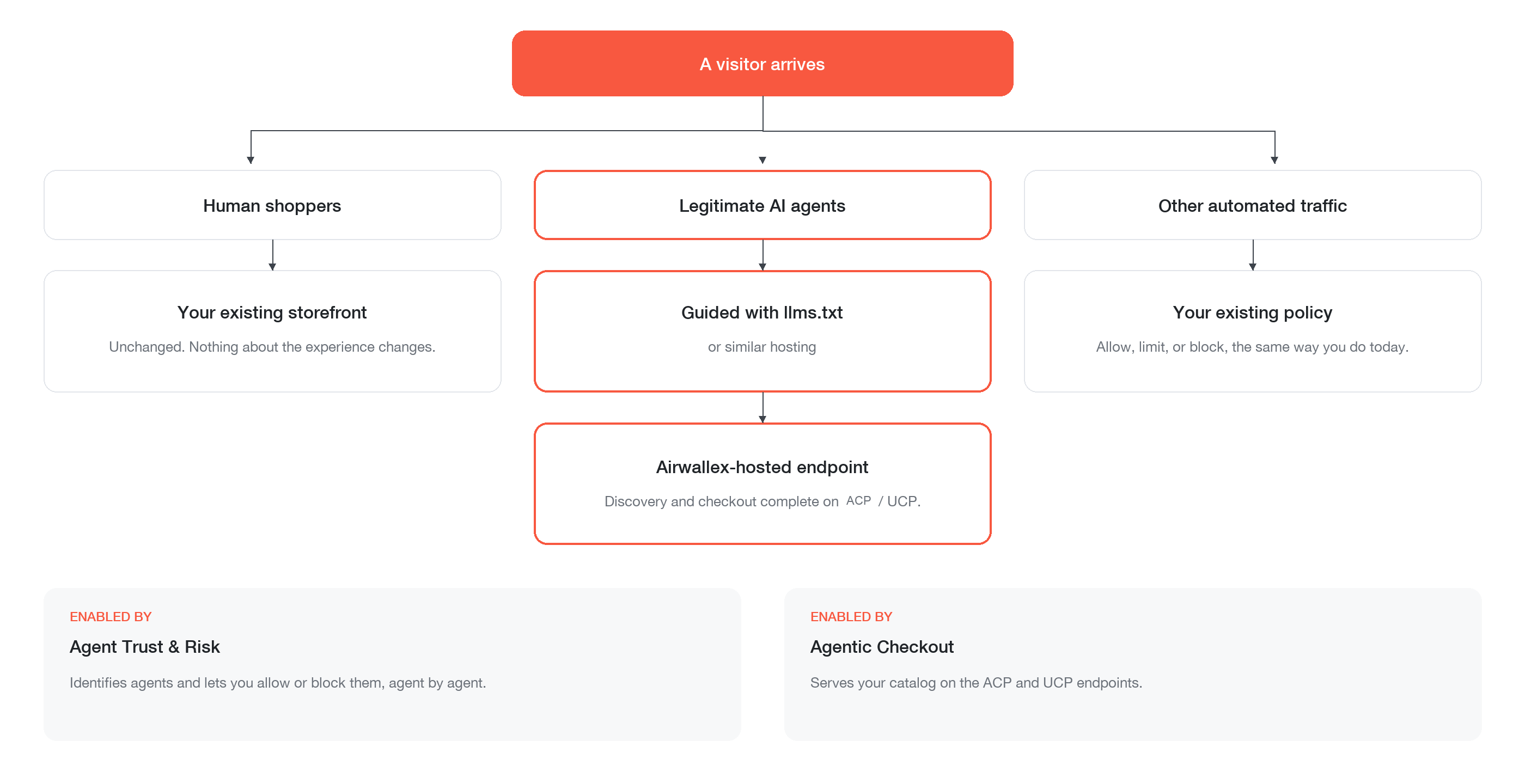
Airwallex identifies each visitor and routes it to the right experience. Airwallex does not block traffic on your behalf.
- Human shoppers continue to your storefront, unchanged.
- Legitimate AI agents are guided to the Airwallex-hosted agent endpoint when the external AI surface requires that configuration. Discovery and checkout complete there.
- Other automated traffic is handled by your existing policy: allow, limit, or block, as you do today.
You keep your storefront, your checkout, and your chatbot. Nothing is replaced.
End-to-end purchase
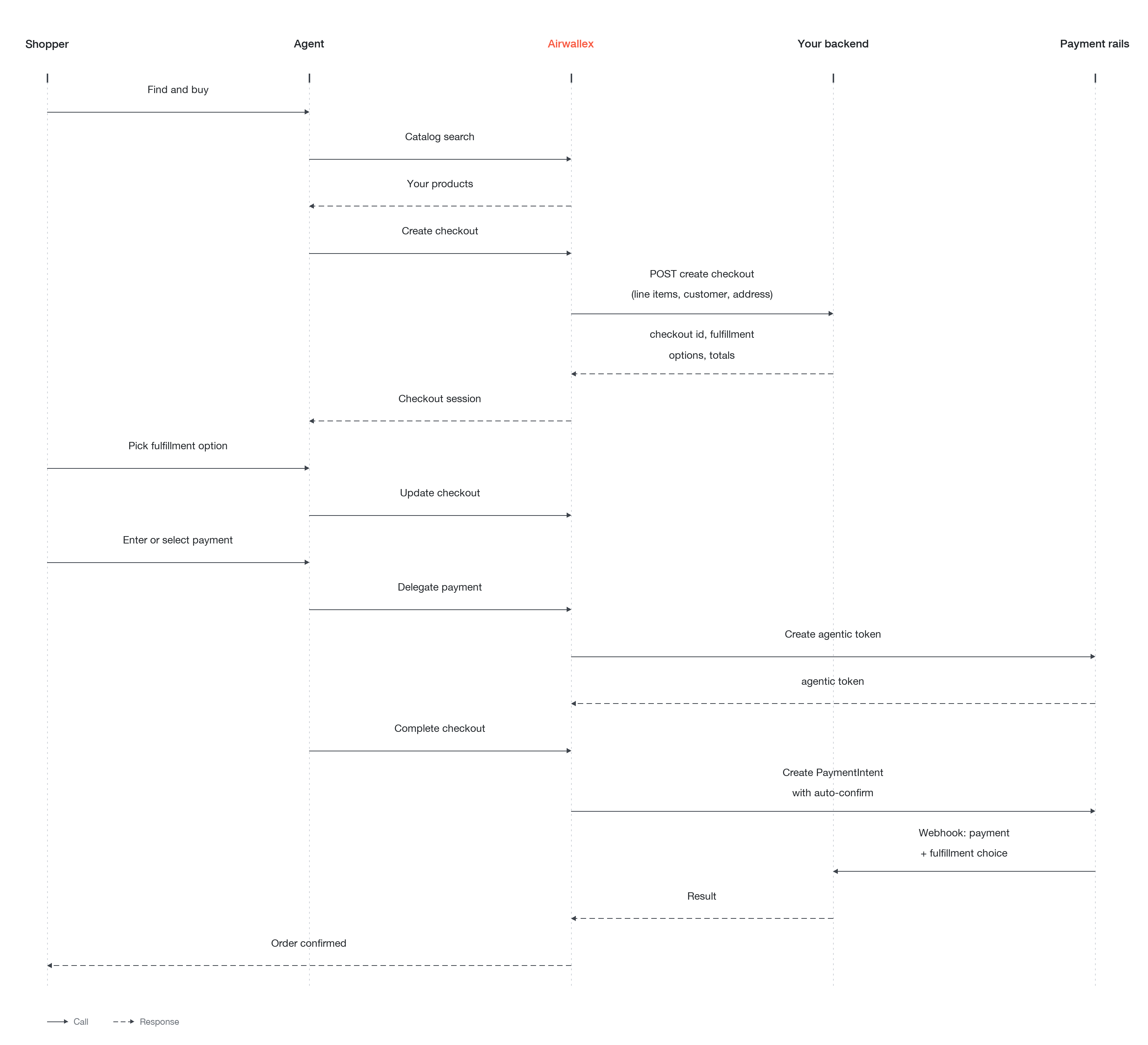
On an end-to-end purchase you take part at each point in What you still manage.
- You send Airwallex the catalog and keep it current.
- On your own storefront, your chat app calls your session token endpoint and receives a Bearer token. On an external surface, a signed-in shopper uses your OAuth server, and Airwallex validates that token against your JWKS URL. A guest on an external surface has no shopper credential.
- Chat completions apply when the conversation uses the Assistant SDK. When Airwallex hosts the model, the SDK calls
https://copilot.airwallex.com/v1/chat/completions. When you host the model, the SDK calls the chat completions URL you provide. - Airwallex calls your create checkout API when a shopper commits to a basket. You return availability, fulfillment options, and totals.
- Airwallex sends you one PaymentIntent Webhook after payment. You fulfill the order.
Treat create checkout as intent, not as an order. A shopper can abandon it. The Webhook is the only signal that money moved.
Reconcile with the list PaymentIntents APIAPI to confirm a PaymentIntent matches the checkout you returned. Airwallex sets merchant_order_id to the checkout id you returned from create checkout. Look the PaymentIntent up by that id. Sell on your own storefront covers both calls.
What stays yours
You remain legally responsible for every sale, and your systems have the final word on every agent-led order. Product data, availability, pricing, and fulfillment stay with you. So do customer data and the customer relationship.
The integration is the touchpoints in What you still manage.
Choose how you use it
Settle which surfaces you want to sell on, and how much of the journey Airwallex runs, before you start building.
Where products are sold
Your products can reach shoppers in a chat on your own site, or on an external AI surface.
- Your own storefront. A chat on your own site, run by your own agent or by the chatbot provider you already use. If a conversation does not happen on your site yet, add one with the Assistant SDK. On the end-to-end path you supply a product feed, a create checkout API, and a session token endpoint. Airwallex runs search, cart, and checkout inside the chat and takes the payment. On the payment-only path your assistant already manages discovery, stock, and prices. You create the PaymentIntent, and Airwallex collects the card. Either way, you fulfill when the PaymentIntent Webhook arrives. See Sell on your own storefront.
- External AI surfaces. ChatGPT, Claude, and Gemini. These surfaces are coming soon. Ask your Account Manager which surfaces are open for your account. The agents speak ACP or UCP, and Airwallex is the connection to them. You use the same catalog, the same create checkout API, and the same PaymentIntent Webhook as on your storefront. Signed-in shoppers use an OAuth server and a JWKS URL. On the payment-only path the surface already runs discovery, and you create the PaymentIntent. Nobody on the agent side builds anything for you. See Sell on external AI surfaces.
How much of the journey Airwallex runs
An agent never sets the price. Whatever an agent says a basket costs, that figure cannot be what the shopper is charged. The price has to come from a party you trust. Either Airwallex calls your systems for the price at the moment of checkout, or you set the price yourself and hand the agent a payment that is already priced.
| End to end | Payment only | |
|---|---|---|
| Use case | Airwallex runs discovery and takes the payment. | You already run discovery. Airwallex takes the payment. |
| Who runs discovery and checkout | Airwallex | You, or your chat provider |
| How Airwallex learns the price | Airwallex calls your create checkout API | You create the PaymentIntent, with the amount |
| What you supply | A product feed and one create checkout API | A PaymentIntent for each order |
| How you learn the order is paid | PaymentIntent Webhook | PaymentIntent Webhook |
Whichever you choose, you stay legally responsible for the sale, and you learn that the order is paid from the same PaymentIntent Webhook.
See also
- Enable Airwallex Agentic Commerce Suite
- Sell on your own storefront
- Sell on external AI surfaces
- Test and go live