Best way to pay overseas suppliers: A UK business guide

Alex Hammond
Senior Fintech Writer

Key takeaways
With international transfers, you have competing priorities: Fees and FX costs, security and safety, and speed. You want a payment provider that can meet all three.
Payment fintechs are generally the best option for paying overseas suppliers. Compared to other options, they offer the best combination of flexibility and affordability.
Airwallex specialises in international payments, with like-for-like settlement in 60+ countries, 160+ local payment methods, and savings of up to 80% on FX fees.
Working with an overseas supplier can mark an exciting time for your business. A new manufacturer with better costs and volumes, a freelancer to help on a specialist project, or a partner to help you expand into new markets. Whatever your reason, it’s often momentous.
The less glamorous truth is that moving money across borders adds complexity to your finances. Managing costs, timescales, and security are imperative to keeping these relationships productive and affordable.
In this article, we’re going to explain the best ways to pay overseas suppliers – exploring a range of options and their pros and cons.
How to pay an overseas supplier
If you’ve got a UK business bank account, the default approach would be to use a SWIFT transfer to get money across borders.
To send a Society for Worldwide Interbank Financial Telecommunications (SWIFT) payment, you’ll need to:
Get your supplier’s name, address, bank name, Bank Identifier Code (BIC) and International Bank Account Number (IBAN).
Go to your bank’s online payments page and find the page for international transfers. You may be able to get a paper version of the SWIFT form (either in a branch or to print yourself), but it varies by bank.
Complete all the fields required. As well as the information in step 1 you’ll also need to enter the amount to transfer and the currency.
Review the information (double-check for any errors) and confirm the transfer.
Wait for the payment to arrive – between one and five days is commonly cited as an expected timeline.
Step-by-step: paying an overseas supplier with Airwallex
The process of using Airwallex to pay your overseas supplier is simple and incredibly fast. Once you’ve opened an account, it’s done in just a few steps:
In your multi-currency account, add your supplier as a new payee.
Select the currency and payment method for your transfer.
Confirm your FX rate and the overall cost of the transfer.
Send the payment and get confirmation from Airwallex.
Track the payment via your Airwallex dashboard and either manually or automatically (with our software integrations) reconcile the payment.
90% of international transfers with Airwallex arrive on the same day, because 90% of them use local payment rails. As far as the accounts are concerned, your payment isn’t international at all.
Optional extra steps:
Generate a purchase order, to maximise your spend control and visibility.
Use Bill Pay to organise your accounts payable into a more streamlined process.
Simplify global payouts with our API, creating customised internal processes and tools.
Common methods to pay international suppliers
Airwallex isn’t your only option for paying overseas suppliers. Variety is a good thing, given how important international payments are to UK businesses.
Back in 2021, 25% of SMEs were sending international payments.1 Two years later, 50% of SMEs reported doing more international trade vs. 2021.2 UK government data for 2024 showed business imports grew by 3% year-over-year.3
The direction of travel is clear – UK businesses are more global than ever.
Traditional bank transfers (SWIFT payments)
We covered this already, but SWIFT is, in some ways, your easiest option. You have a business bank account already and it can be used to send money to other bank accounts – including foreign ones. It’s a reliable system and keeps your money within the traditional banking network.
Easy isn’t always for the best, though. SWIFT is relatively slow and expensive (e.g. a £15 fee before any currency conversion costs) – two important factors to consider, especially when you make regular international payments.
PayPal and other digital wallets
Other digital wallets are available, but PayPal is one of the best-known brands in the world and works well to make this point. All you need is the recipient’s email address or phone number and you can send them their money.
One of the biggest drawbacks with digital wallets is that there’s no way to manage these payments at scale. One person needing one payment to a wallet is manageable, but dozens of suppliers with dozens of invoices creates a huge workload with very little benefit to your business.
Debit and credit cards
If your overseas supplier uses a payment gateway, they should be able to offer you the option to pay by card. Many payment platforms can even embed payment links in invoices, so you can pay directly from them. If you get cashback or points for your card spend, this can be a great way to maximise your returns.
The issue here is similar to that with digital wallets – it’s not scalable and it’s not in your control. The manual process of paying one supplier via credit card is a different beast compared to paying hundreds or even thousands of them.
International money transfer services
Money Transfer Operators (MTOs) like Western Union and XE are great for paying individuals, but less so for businesses. You might find that you need to pay a freelancer to their personal account using an MTO, but the wider B2B case is limited.
Fintech platforms
Payment fintechs like Airwallex offer the best balance of speed, affordability, and security out of all these options.
Compared to traditional banks, a transfer made from an Airwallex account can be magnitudes cheaper. For example, sending an international payment via SWIFT with one high-street bank costs £15 – before accounting for their conversion costs, FX margins, and other fees. Sending using Airwallex’s local rails will cost you 0.5% - 1% (depending on the currency). It could even be free if you already hold a balance in that currency in your account.
An international payment specialist can get your transfer to your supplier in a matter of hours, rather than the days or even weeks that other options take.
Paying overseas suppliers: the basics
If the first time you think about paying your overseas supplier is on receipt of their first invoice, you might have a problem.
International payments involve moving money between currencies, countries, and banking systems. It’s more complex than paying a UK supplier and comes with more risks and challenges, as a result. You’ll have to account for:
The time it takes for transfers to send.
What FX mark-ups and fees you’ll have to pay.
How transparent and traceable your payments are.
Whether you or they are subject to any payment limits.
How easy it is to reconcile international payments in your business.
Making a plan for how you’ll handle these payments is good practice and could save you from a costly mistake.
Comparing international payment methods: pros and cons
We’re confident that fintechs (like Airwallex) are the best choice for paying your international suppliers. We’re also aware that no platform is perfect – there are pros and cons to every option and it’s right that you assess them accordingly.
| Pros | Cons |
|---|---|---|
Airwallex (or other fintech) | Speed, cost, security | Onboarding a new system or duplicating some tools you already use |
Traditional bank | Reliability and reputation | Speed and cost |
Digital wallet | Simplicity and reputation | Scalability, traceability, cost, and risk of fraud/error |
Card payment | Simplicity and rewards | Scalability, cost, and payment limits |
International money transfer | Reach and accessibility | Scalability, cost, not tooled for B2B |
Your situation will throw up its own unique requirements, so there might be pros and cons that we haven’t included in the table above. As always, it’s worth doing your own research into these options.
How to reduce costs when paying overseas suppliers
There will always be costs involved if you’re moving money internationally, which means there is always room for you to control and mitigate these costs. We’ve added some of our top tips for making your overseas supplier payments a little lighter on your bank balance.
Open an account in their preferred currency, so you can use faster and lower-cost local payment rails for each transfer.
Negotiate payment terms with your supplier, for example reducing the total number of payments you make or negotiating to a more affordable third currency.
Use batch payments to pay all of your suppliers in one go. You’ll need a platform that can handle multi-currency payments if you’re including overseas suppliers.
Automate your payments based on stop-limit currency conversions, so you only pay an invoice at the best-possible exchange rate.
Use a method that integrates with your bookkeeping and accounting system(s) for automatic reconciliation.
Use an international payment fintech (e.g. Airwallex) to get all of these suggestions in one simple, intuitive package. Low-cost FX, stop-limit conversions, local payment rails, and other useful features
Security and compliance in cross-border payments
Sending money across borders and banking systems increases your risk exposure. It’s not inherently unsafe – millions of these payments are made every day – but the complexity involved is far greater than paying your electricity bill, for example.
There are several steps you can take and policies you can implement to reduce your risk:
Verify your supplier’s details, double-checking all account numbers and the value of each payment, to avoid mistakes.
Practice supplier due diligence, based on your business’ needs and regulations. If you can, invest in Anti-Money Laundering (AML) and Know Your Customer (KYC) tools to vet your suppliers.
Use an FCA-regulated provider, so you can be confident you’re sending money with a legitimate and reliable payments platform.
Ensure that all payment data is encrypted, secure, and traceable – you might have to ask a payment provider for this evidence, but they should be able to explain with no issues.
Depending on where your customer is based, make sure your payment method complies with local laws and regulations – e.g. Payment Services Directive 2 (PSD2) in Europe.
Comparison table: payment methods for overseas suppliers
Want a quick overview of how these different overseas payment options stack up? Check the table below – the more stars, the better our rating.
| Cost | Speed | Security | Traceability |
|---|---|---|---|---|
Airwallex (or other fintech) | ⭐️⭐️⭐️ | ⭐️⭐️⭐️ | ⭐️⭐️⭐️ | ⭐️⭐️⭐️ |
Traditional bank | ⭐️ | ⭐️ | ⭐️⭐️⭐️ | ⭐️⭐️ |
Digital wallet | ⭐️⭐️ | ⭐️⭐️⭐️ | ⭐️⭐️ | ⭐️ |
Card payment | ⭐️⭐️ | ⭐️⭐️⭐️ | ⭐️⭐️⭐️ | ⭐️ |
International money transfer | ⭐️ | ⭐️ | ⭐️⭐️ | ⭐️⭐️ |
It’s a simple way of looking at your options, but sometimes simple is best.
How Airwallex helps UK businesses pay overseas suppliers
Using Airwallex to pay your international invoices turns a complex process into something much simpler – and more affordable.
Using Airwallex, you can send payments to 150 countries – using local rails for over 120 of them. That means you can pay your suppliers as if you’re local to them, wherever they are. This is far cheaper than international payment methods like SWIFT and much quicker. ~90% of our transactions process on the day they’re sent (usually within a few hours).
You’ll also save on FX. With Airwallex, you pay 0.5% above the mid-market rate for major currencies and 1% above it for others. No hidden fees, no secrets. Plus, with local account details available in 60+ countries, you can hold foreign currencies on your balance and use them to pay suppliers without ever having to convert them.
Beyond sending payments, you also get features like recurring payments and stop-limit currency conversion. Plus, with our spend management system, you can add each invoice as a bill to be paid and process it at the right time – and in bulk, with other bills, if you want.
The costs of paying overseas suppliers varies wildly
There are plenty of options for sending cross-border payments and, between them, the difference is huge. Timescales, costs, and flexibility all matter, but each option takes a different approach and prioritises different things.
Just as banks and MTOs can be slow and expensive, digital wallets and card payments don’t work at scale. Airwallex and other international payment processors offer the best of all worlds – speed, cost, convenience, and flexibility in one place.
If you want to take the complexity out of paying overseas suppliers, choose Airwallex.
FAQs
How easy is it to pay a supplier in another country?
It can be extremely easy to pay overseas suppliers, depending on the payment method you use. Most business bank accounts can send these payments, but at a high-cost and relatively slowly. You can use fintechs like Airwallex to send cross-border payments for up to 80% less using local payment rails, with your payment arriving on the same-day nine out of 10 times.
What do I do if I get an invoice in a different currency?
As long as your contract says you’ll pay the invoice in that currency, you’ll have to go ahead and do it. There are lots of options, but the best way is to use an international payments fintech like Airwallex.
You can send money to 150+ countries, using local rails in over 80% of them. This means you’ll pay lower fees than using your UK bank account and your payment will arrive quickly and in their preferred currency.
Can I use multiple currencies in my business?
Yes, you can. For businesses that have suppliers in other countries, this can be a great way to manage their payments. Most UK banks will let you open a business account in another currency; usually US Dollars or Euros. These tend to be charged as an extra cost each month.
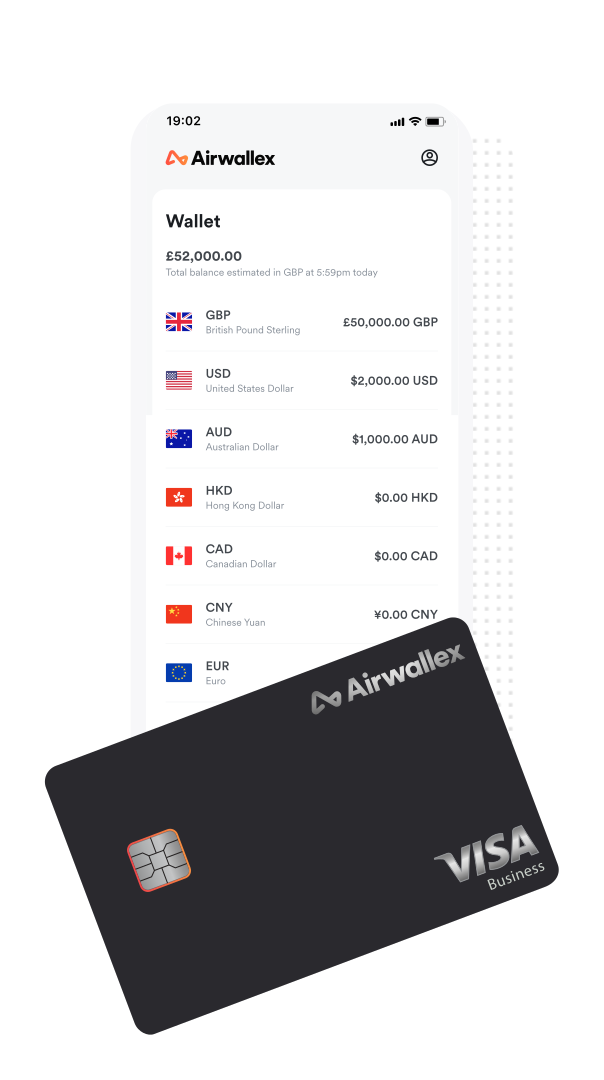
Alternatively, you can use platforms like Airwallex that let you open domestic and foreign currency accounts in over 60 countries – all within one platform, with low-cost foreign exchange between these accounts (and to other, external accounts) saving you time and money.
How long does it take to send money abroad?
It all depends on the method you use. From your UK business account, a SWIFT payment can take a few days or up to a week. A card payment will take a few days to clear. With a fintech like Airwallex, you can use local payment rails to transfer money overseas at speed. Over 90% of the payments we process arrive on the same day.
Sources and references
Alex Hammond
Senior Fintech Writer
Alex is a senior Fintech writer at Airwallex with over eight years of experience writing for leading finance and technology brands, such as Lightspeed and Xero. At Airwallex, he writes practical content on payments, financial operations, and international growth for businesses scaling across global markets.
Posted in:
Business bankingShare
- How to pay an overseas supplier
- Step-by-step: paying an overseas supplier with Airwallex
- Common methods to pay international suppliers
- Paying overseas suppliers: the basics
- Comparing international payment methods: pros and cons
- How to reduce costs when paying overseas suppliers
- Security and compliance in cross-border payments
- Comparison table: payment methods for overseas suppliers
- How Airwallex helps UK businesses pay overseas suppliers
- The costs of paying overseas suppliers varies wildly
Create an Airwallex account today
Share


Open a business account built for growth

Reach new markets with foreign currency accounts

Transfer funds across the globe, without excessive fees

Empower your team to make purchasing decisions
