A guide to optimising payment success rates

Ross Weldon
Contributing Finance Writer

Key takeaways
Failed payments cost revenue and break customer relationships at the moment of highest intent.
High-volume businesses recover millions with small wins: a 0.5% approval rate lift transforms your bottom line.
Airwallex Optimize 360 uses AI-powered optimisation to balance conversion, cost, and fraud across every transaction.
It takes time, money, and effort to win a customer. eCommerce businesses spend $86 on average to acquire each one. B2B SaaS companies spend closer to $239.1 All of that can be wasted if the transaction fails at the moment of truth, when someone clicks “Buy now.”
When customers are ready to buy, that intent is fragile. Whether it's an impulse purchase or a time-sensitive decision, any friction or failure dramatically increases the risk of abandonment.
These failures create lasting damage. 40% of customers won’t return to a merchant if their card is declined, and 52% will abandon checkout if it takes more than two minutes to process a purchase.2 For companies selling in multiple markets, the checkout experience is more complex. Local payment preferences, currency complications, and regional banking behaviours all impact success rates. What works in New York may fail in Sydney. What clears in London may be blocked in São Paulo.
Success depends on how well you manage the tradeoffs. You need to increase conversions without driving up fraud. You need to reduce cost without hurting performance. If you’re processing millions in annual payments, even a modest 0.5% lift in approval rates can recover a significant amount of lost revenue. Optimising payments means finding that balance, then making it work across every market you operate in.
What is payment success rate optimisation?
Payment success rate optimisation means getting more transactions approved on the first try, as well as providing support to ensure recurring payments are managed without a hitch. Every transaction that goes through on the first attempt means less friction for your customers and more revenue for your business. Simple in theory. Complex in practice.
Every payment request travels through a complex web of decisions. Imagine a customer in São Paulo using a Visa credit card to buy a pair of sneakers from your online store at 2:47 pm:
The customer clicks “Buy Now,” and your checkout sends the transaction data to the payment processor.
The processor chooses the best acquiring path to route the payment, often based on factors like location, cost, historical performance, etc.
The acquirer formats the authorisation message for the card network using standard ISO 8583 fields.
Visa’s network receives the request and sends it securely to the customer’s bank.
The bank’s fraud system checks multiple signals: international merchant, online purchase, sneaker retailer, time of day, and the card type.
The transaction is approved, and the customer’s order is confirmed.
Change any variable and you get a different outcome. Route through a different acquirer and the formatting changes. Hit the bank at 11pm and the fraud score jumps. Use a personal card instead of corporate and new risk triggers fire. Now multiply this complexity across millions of transactions, dozens of markets, and hundreds of card issuers – each with different preferences and behavioural patterns that shift constantly.
This is why traditional optimisation techniques fail. To succeed, optimisation requires systems that adapt in real-time, learning from every transaction and making thousands of split-second decisions. The businesses that master this unlock millions in revenue that others leave on the table.
Understanding the payment journey
Every successful payment depends on a complex chain of handoffs. If one step breaks, the whole thing fails. Understanding who's involved helps you spot where things go wrong and where optimisation can have the biggest impact.
Checkout: It starts here: transaction amount, card type, billing address, device info. Missing or misformatted data, or the wrong payment method mix can cause declines before the request even leaves your platform.
Payment gateway: Technology that encrypts and transmits transaction information from the merchant to the payment processor.
Payment processor: Receives the request and forwards it through an acquirer. Smarter processors use dynamic routing to maximise approvals. Others rely on static rules or prioritise cost over success rates. Processors also run fraud pre-checks and authentication (in addition to the checks that issuers perform later).
Acquirer: Your acquiring bank becomes your representative in the card networks. They translate your transaction into ISO format, add the right merchant category codes, and send it on its way. Think of them as your translator, making sure your request speaks the language each network expects.
Card network: Visa, Mastercard, or another scheme receives the request and sends it to the cardholder's bank. Networks also manage compliance rules and settlement between parties.
Issuer: The customer's bank makes the final decision. Their fraud engine runs hundreds of checks in milliseconds: Is this card normally used in Tokyo at 2am? Does a $847 software purchase match this customer's spending patterns? Has this device been flagged before? These signals determine approval or decline.
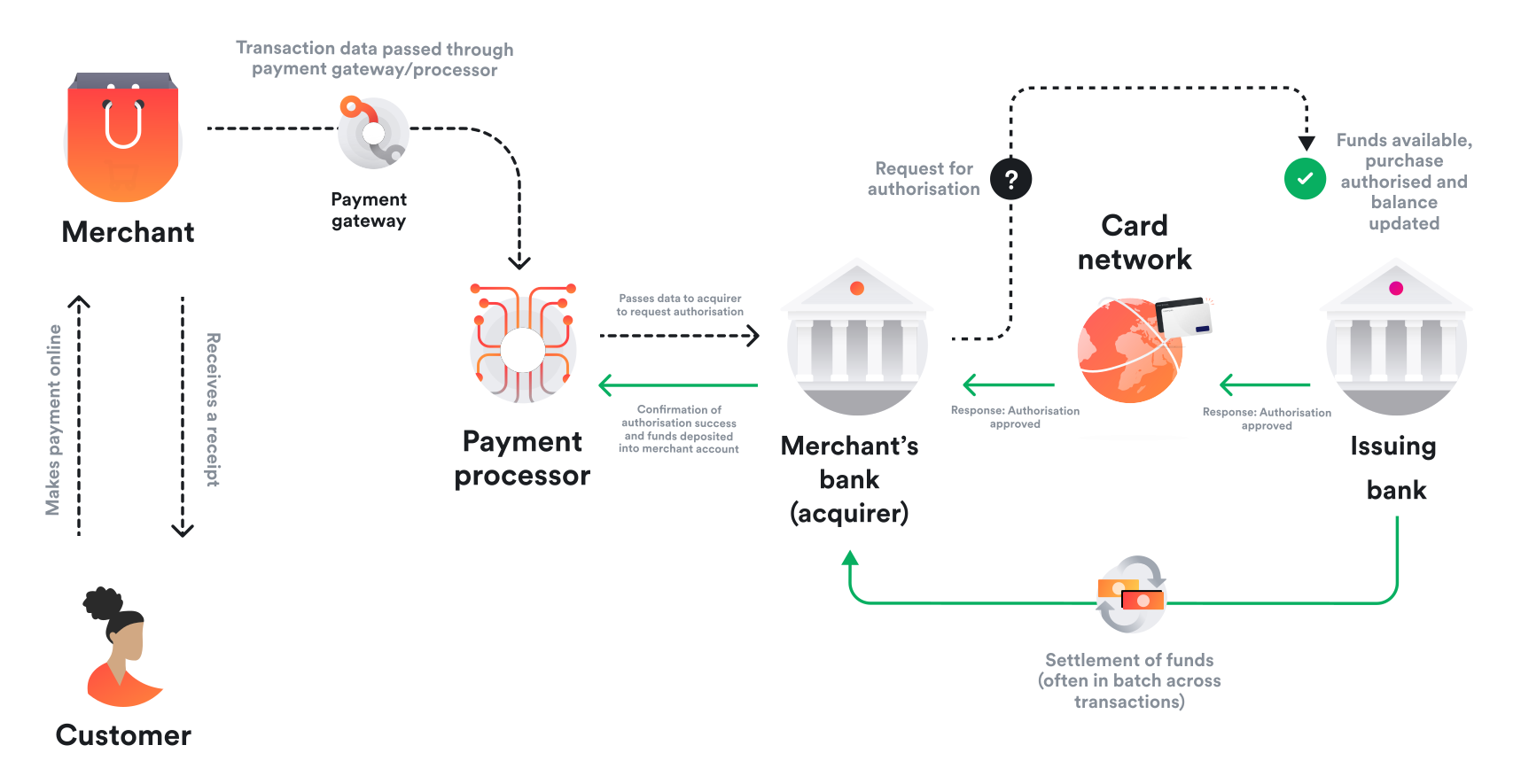
Most declines happen at the issuer level. Often, they're not about fraud but small mismatches, poor timing, or transaction formatting the bank doesn't recognise. When you understand this journey, you can see why generic optimisation fails. Each step needs different tactics, and success depends on how well they all work together.
Modern providers like Airwallex perform many of the functions listed above, which can streamline the payment process. Airwallex operates as a payment gateway, payment processor, and acquirer for customers, and is also a card issuer. When the payment flow is managed this way, success rates can be better optimised.
Key areas for payment optimisation
Every transaction is a delicate balancing act between three competing forces: conversion, cost, and fraud. You want more approvals. You want to control fees. And you want to block bad actors without blocking your best customers. Optimisation works when you improve one area without harming the others.
Here are the key areas to focus on:
🟣 Acceptance rates
This is where most teams start, and rightly so. Approval rates are the clearest indicator of payment performance. But getting them up isn’t about blunt-force routing or retry spam. It’s about timing, message formatting, issuer behaviour, and live signals.
Consider the cardholder’s bank. It needs the right data, in the right format, at the right time. Miss any of those, and your transaction might get flagged or dropped, even if the customer has funds and intent. Optimise this, and you recover revenue without changing your acquisition strategy.
🟣 Cost efficiency
Payment optimisation isn’t just about approvals – it’s about keeping fees under control too. Every transaction has a cost, from interchange and network fees to gateway charges.
Optimising for cost means routing transactions intelligently, choosing the right acquirers for each region, and leveraging local payment methods where possible. It’s about reducing unnecessary cross-border fees without impacting approval rates or customer experience. The result? You keep more of every sale while still delivering fast, reliable payments globally.
🟣 Fraud protection
Fraud controls are there for a reason. But if they’re too strict, they’ll block good payments and create false declines. If they’re too loose, you’ll see chargebacks and disputes pile up. Optimisation helps you apply the right risk checks in the right moments.
Think device signals, behavioural patterns, and past transaction history. With the right tools, you can trigger step-up authentication only when needed, reduce manual reviews, and stay compliant without hurting your approval rates.
🟣 Customer experience
Your payment experience speaks louder than your product copy. If the checkout feels slow, unclear, or untrustworthy, customers will abandon. If it works smoothly but triggers 3DS every time, they’ll still leave.
Optimising for customer experience means choosing the right local payment methods. It means adapting to mobile. It means using network tokens so returning customers don’t get declined due to expired cards. The smoother the path to payment, the stronger the relationship.
Building your payment success rate optimisation strategy
The businesses with the highest success rates apply intelligence across every stage of the transaction lifecycle, using real-time data and infrastructure-level control to adapt dynamically and at scale.
🟣 Optimising the checkout
Checkout optimisation
The way customers interact with your checkout can make or break a payment. Optimise for speed, clarity, and trust. Streamlined flows, mobile-first design, and clear error messaging reduce abandonment. Even small tweaks like minimising required fields or offering guest checkout can significantly improve approval rates without touching your back-end systems.
Optimal payment method mix
Not every customer pays the same way. Offering a diverse set of payment options such as local cards, wallets, BNPL, or bank transfers lets customers choose what they trust. An optimal mix also boosts approval rates by aligning payment methods with local issuer behaviours and customer preferences. Tailor your offerings by region and watch conversions climb.
Localised payment processing
What works in one market may underperform in another. Issuers in each region expect different data formats, authentication flows, and routing behaviours. Optimising success rates means tailoring the transaction to meet those expectations. That could mean applying specific ISO field configurations, choosing a local acquirer, or offering region-specific payment methods.
🟣 Strengthening security
Fraud scoring
Preventing fraud is essential, but blocking too many transactions kills revenue. Fraud scoring uses real-time risk signals such as device fingerprinting, transaction history, geolocation, and behavioural signals orchestrated by AI models in real time to make smarter decisions. High-risk payments get extra checks; low-risk ones glide through. The result: fewer declines, fewer chargebacks, and more revenue safely captured.
Optimising 3DS
Similarly, 3DS adds security and supports regulatory compliance, but it can also disrupt conversion if applied too broadly. Optimisation involves assessing each transaction in real time to determine whether step-up authentication is necessary. That requires inputs like device fingerprinting, behavioural history, and issuer preferences. Machine learning systems can support optimised 3DS targeting, to reduce drop-off while maintaining risk controls.
🟣 Maximising opportunities
Smart routing
Routing has a direct impact on approval rates, cost, and fraud exposure. Hardcoded logic is easy to implement but often underperforms. A more advanced approach uses real-time data, often analysed by AI, to select the most reliable path for each transaction, considering issuer performance, currency pairings, network conditions, and past success trends. This reduces preventable declines and gives you more control over outcomes.
Smart retries
Not all failed payments are final. Many can be recovered, but only if retried with the right timing and context. Instead of applying fixed retry intervals, smart retry systems use insights from issuer response patterns and user behaviour to choose the optimal moment to try again. This is especially effective in subscription models and high-frequency billing scenarios.
🟣 Ensuring recurring revenue
Network tokenization
Stored card credentials often fail without warning. A card expires or is replaced, and the transaction drops. Network tokens help prevent that. They replace static card numbers with dynamic credentials that update automatically across issuers. For recurring payments and returning customers, this significantly reduces avoidable declines and keeps payment flows uninterrupted (while lowering interchange fees).
Account updater
Expired or replaced cards are a silent killer of recurring revenue. Account updater services automatically refresh stored card details across networks and issuers, keeping subscriptions and repeat payments alive. For businesses relying on recurring billing, this is one of the simplest yet most effective ways to reduce avoidable declines.
Data monitoring and insights
Visibility of issuer-level data, normalised response codes, and real-time signals are needed to understand where and why transactions are failing. Systems powered by machine learning can go further, identifying patterns and surfacing root causes before they affect approval rates. With the right feedback loops, your team can stop guessing and start improving.
Why manual optimisation doesn’t scale
Manually improving payment performance is a full-time job. Every failed transaction requires digging into issuer responses, analysing patterns, adjusting routing rules, and testing retries, often across multiple gateways and currencies. Multiply that by dozens of payment methods, dozens of regions, and thousands of daily transactions, and it quickly becomes overwhelming. Even experienced teams struggle to keep up, leaving revenue on the table and introducing costly errors.
With the right tools, much of this heavy lifting happens automatically. Real-time data, smart routing, fraud scoring, and account updater services all work together to optimise approvals, reduce fees, and protect revenue, without draining your team’s time and resources.
Unlock hidden revenue with Airwallex Optimize 360
Every decision made in the payment flow affects three critical outcomes: conversion, cost, and fraud. Payment optimisation is about achieving the right balance. You want to maximise conversion, control costs, and reduce fraud, all at the same time.
Airwallex’s AI-powered optimisation engine is built to continuously balance these forces. It helps global businesses unlock revenue while reducing cost and risk. By combining machine learning, issuer-informed decision-making, and infrastructure-level control, Airwallex Optimize 360 makes optimisation scalable, intelligent, and business-aware.

Unlike reactive tools or generic orchestration layers, Optimize 360 operates within the acquiring stack. It applies dynamic adjustments in real time, supports proactive root-cause analysis, and delivers consistent performance across global markets. From checkout configuration to retries, routing, authentication, and tokenization, optimisation is embedded at every stage.
Payments are a core part of your business. Optimisation needs to be a core capability. With the right foundation in place, you’ll stop revenue leakage, protect customer relationships, and build a more resilient payment operation, one that works harder with every transaction.
FAQs
What is payment success rate optimisation?
It’s the process of increasing the number of payments that succeed on the first attempt. That means fewer declines, fewer drop-offs, and more revenue captured without adding friction for the customer.
Why do payments fail even when the customer has money?
Most declines come from the issuer, often due to incomplete data, poor formatting, or fraud rules that misread the transaction. These aren’t customer errors, they’re system-level issues that can be fixed with the right optimisation tools.
How is Airwallex Optimize 360 different from other solutions?
Optimize 360 is built directly into the acquiring stack. While many competitors rely on manual rules, Optimize 360 uses self-learning AI to choose the right treatment at every step of the payment flow. It uses machine learning and real-time issuer data to adapt routing, retries, authentication, and more, without relying on bolt-on tools or third-party orchestration.
What kind of impact can optimisation have on revenue?
Even a 0.5% lift in approval rates can recover millions in lost revenue for high-volume businesses. Optimisation also reduces fraud losses and support overhead, helping you grow with less waste.
Source:
https://firstpagesage.com/reports/average-customer-acquisition-cost-cac-by-industry-b2b-edition-fc/
Forbes; 2025 AFP Payments Fraud and Control Survey; Digital Commerce 360 Survey; Oxford Economics Research
View this article in another region:Canada - EnglishCanada - FrançaisChinaEuropeFrance - EnglishFrance - FrançaisIsraelJapanNetherlands - EnglishNetherlands - NederlandsUnited KingdomUnited States
The material presented here is for informational purposes only and does not constitute legal, regulatory, taxation, or investment advice. Readers should engage their own advisors or counsel for advice unique to their circumstances.
Ross Weldon
Contributing Finance Writer
Ross is a seasoned finance writer with over a decade of experience writing for some of the world's leading technology and payments companies. He brings deep domain expertise, having previously led global content at Adyen. His writing covers topics including cross-border commerce, embedded payments, data-driven insights, and eCommerce trends.
Posted in:
Online payments

